Goal
Generate vertical lift / anti-gravity thrust without interacting with air, water or a solid surface.
Problem
Provide a new form of propulsion that can lift objects or vehicles without conventional aerodynamic or reaction-based forces.
Concept Summary
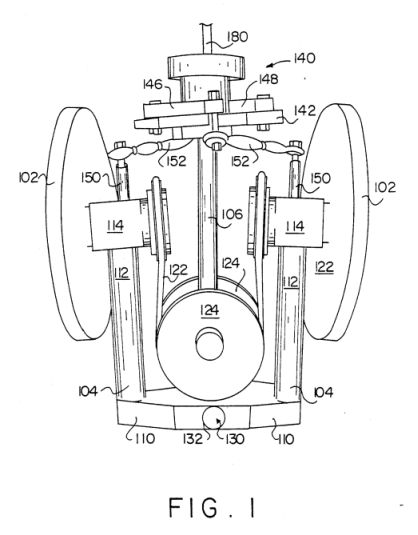
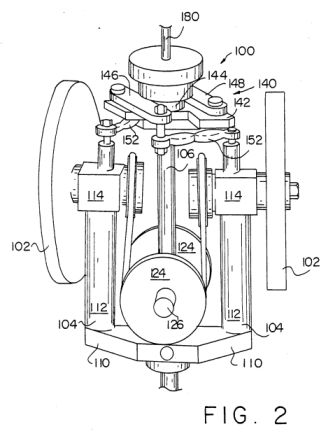
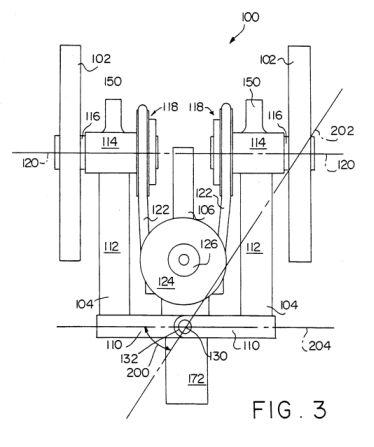
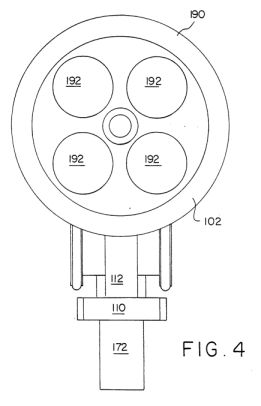
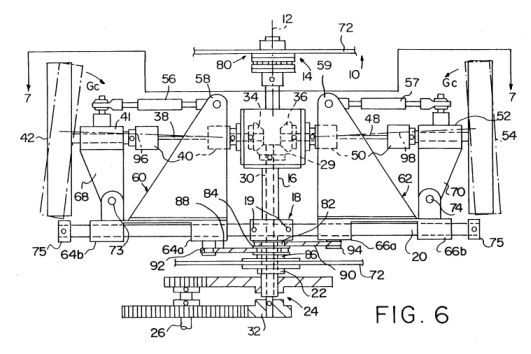
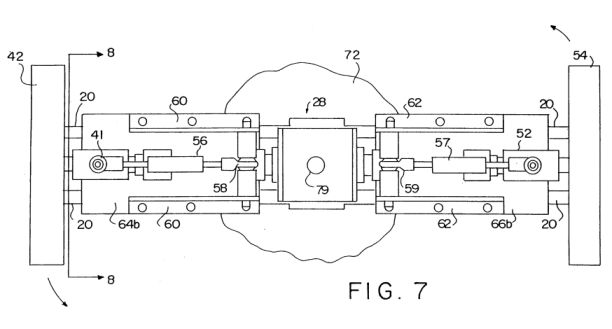
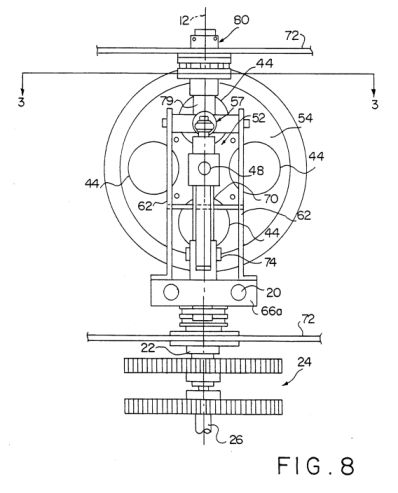
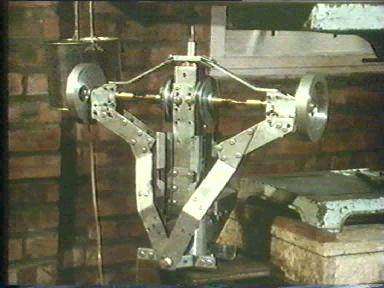
The Kidd Machine uses a pair of high-speed gyroscopic discs mounted on opposite arms. The discs spin in opposite directions while the whole assembly rotates about a second axis. A cam-driven mechanism periodically forces the discs to pivot, producing pulsatile forces via gyroscopic precession that result in an upward thrust.
Detailed Description
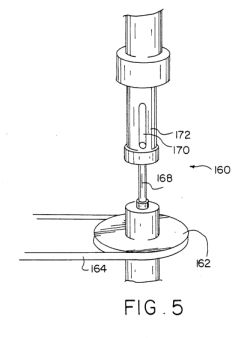
A gyroscopic apparatus comprises two opposed rotatable discs mounted on arms that pivot about a central axis. Drive motors spin the discs in opposite directions and also rotate the entire assembly about a second, perpendicular axis. A camming system periodically pushes the discs toward each other, causing a rapid change in precession direction and generating a pulsatile force along the second axis. The thrust is transmitted through a bearing to produce vertical lift. The device has been demonstrated in laboratory settings using a model aircraft engine as the power source.
Principles
- Gyroscopic precession
- Conservation of angular momentum
- Pulsatile force generation via cam-driven reciprocation
Scientific Domains
Materials
- Metal discs (e.g., steel or aluminum)
- Aluminum or steel arms
- Cam mechanisms (metal or hardened polymer)
- Bearings and pivots (steel)
Mechanisms of Action
- Precessional thrust from rotating discs
- Cam-induced reciprocal motion of gyroscopes
- Conversion of rotational kinetic energy into axial thrust
Energy Sources
Applications
- Spacecraft propulsion
- Lift generation for vehicles
- Experimental anti-gravity research
Claimed Performance
The prototype produced enough thrust to float a small orange and demonstrated measurable weight loss of the device when powered by a model aircraft engine.
Experimental Evidence
Demonstrated at Imperial College for Professor Eric Laithwaite (1984), tested in Melbourne for three days under specialist supervision, and observed by Dr. Bill Ferrier who reported vertical lift and confirmed the effect was not aerodynamic.
Replication Status
Limited independent testing reported; no widely documented replication or commercial scaling.
Limitations
- No quantitative thrust data published
- Energy efficiency not demonstrated
- Lack of peer-reviewed validation
Red Flags
- Claims of defying Newton's third law
- Anti-gravity language without rigorous physics justification
- Patent withdrawn due to funding loss