Goal
Provide lightweight, low-power artificial muscles and flapping wings for insect-sized robots and micro-air vehicles.
Problem
Existing electroactive polymers are relatively heavy and require high voltages; a need for cheap, lightweight, low-voltage actuators for small robotic systems.
Concept Summary
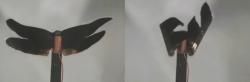
Electroactive paper (EAPap) is a cellulose-based film coated with thin gold electrodes. When a low voltage is applied, ion migration and the intrinsic piezoelectric properties of cellulose cause differential swelling, making the film bend. The material is inexpensive, lightweight, and can achieve large deflections at low power, enabling artificial muscles and flapping-wing micro-air vehicles.
Principles
- Electroactive polymer actuation
- Piezoelectric effect of cellulose fibers
- Ion migration and electro-osmotic swelling
- Differential expansion due to electric field
Scientific Domains
Materials
- Cellulose fibers
- Gold (electrode layer)
- Chitosan
- Acetic acid
- Polyaniline
- Carbon nanotubes
- Sodium alginate
- NaOH
- Urea
Mechanisms of Action
- Gold electrodes inject charge, creating opposite polarity on each side of the film
- Sodium ions migrate toward the negative electrode, dragging water molecules and causing local swelling
- Cellulose fibers with piezoelectric properties change shape under the electric field
- Combined swelling and piezoelectric deformation produce macroscopic bending
Energy Sources
Applications
- Artificial muscles for robots
- Flapping wing micro-air vehicles
- Lightweight sensors and surveillance platforms
- Soft robotic actuators
- Low-power actuation in humid environments
Claimed Performance
A 30 mm strip displaced 4.2 mm at low voltage; a 40 mm strip bent 10 mm and lifted >10 uN; actuation cycle as fast as 0.06 s; required electric field 10-100x lower than conventional electroactive polymers.
Experimental Evidence
In experiments the tip of a 30-mm-long strip of electroactive paper was displaced 4.2 mm; strips 40 mm long and 0.3 mm thick bent by 10 mm producing a force of more than 10 uN; the paper can move back and forth as fast as once every 0.06 seconds.
Limitations
- Performance strongly dependent on ambient humidity
- Limited force output compared with conventional actuators
- Uncertainty about durability in extreme environments (e.g., space)
- Scaling to larger devices may require additional reinforcement