Goal
Accelerate the decay of radioactive isotopes to reduce radioactivity and render nuclear waste less harmful.
Problem
Long-lived radioactive waste from nuclear reactors and accidents such as Chernobyl, which is costly and environmentally hazardous to store.
Concept Summary
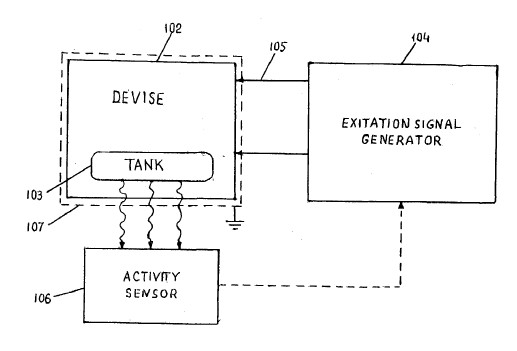
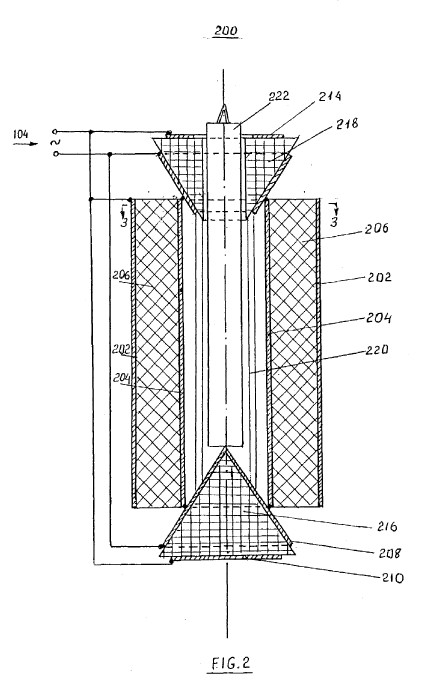
A specially constructed chamber acts as a large hollow capacitor whose dielectric is replaced by ferromagnetic prisms. An AC voltage of selectable frequency is applied to outer and inner electrodes, exciting resonant "structurization" or "destructurization" space-time flows in the ferromagnetic material. These flows are claimed to accelerate nuclear decay, lowering alpha, beta, and gamma emissions from the waste placed inside the cavity.
Detailed Description
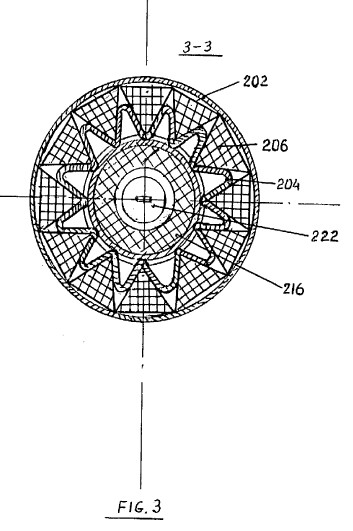
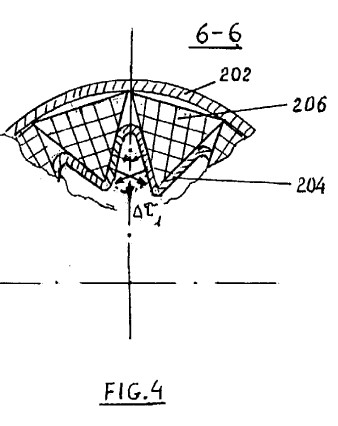
The apparatus consists of a cylindrical outer shell electrode (e.g., stainless steel) and an inner electrode, with a ring of prism-shaped ferromagnetic elements (nickel-zinc alloy 250 VNRP) positioned between them. A container holding radioactive material is placed in the central cavity. An external signal generator supplies an adjustable-frequency AC voltage (typically 10-100 MHz) to the electrodes. The frequency is tuned to match the resonant frequency of the ferromagnetic material, thereby generating focused space-time flows that purportedly increase the probability of nuclear decay events. Radiation sensors (alpha, beta, gamma) monitor the process, and the treatment continues until activity falls to permissible levels or complete deactivation is achieved. The patent describes the geometry of the prisms, material specifications, and the overall system layout, but provides no quantitative performance data.
Principles
- Electromagnetic induction
- Ferromagnetic resonance
- High-frequency AC fields
- Space-time flow (structurization/destructurization) theory
Scientific Domains
Materials
- Nickel-zinc ferromagnetic alloy (catalog 250 VNRP)
- Stainless steel (outer electrode)
- Copper or zinc (possible inner electrode material)
- Metallic container for radioactive waste
Mechanisms of Action
- Resonant excitation of ferromagnetic prisms by AC voltage
- Generation of directed space-time flows that influence nuclear decay rates
- Enhanced alpha, beta, gamma emission monitoring for feedback control
Energy Sources
Applications
- Nuclear waste remediation
- Decontamination of contaminated sites
- Radiological safety improvement
Claimed Performance
Accelerated decay of strontium, cesium, and Chernobyl waste samples demonstrated in laboratory experiments; claimed to be economically feasible compared with high-energy particle bombardment.
Experimental Evidence
The text states that "controlled accelerated decay of strontium, cesium, and Chernobyl samples" has been successfully demonstrated, and that "at least ten successful experiments throughout the world" have shown controlled accelerated decay using high-energy bombardment, with the present approach being the first economically feasible one.
Replication Status
At least ten successful experiments reported in various laboratories worldwide, according to the article.
Limitations
- No quantitative data on decay rate acceleration
- Mechanism relies on non-standard physics concepts (structurization/destructurization)
- Scalability and cost of large-scale apparatus not demonstrated
- Potential regulatory hurdles for handling radioactive material
Red Flags
- Extraordinary claim of altering nuclear decay without clear theoretical basis
- Reliance on proprietary "field theory" not accepted by mainstream physics
- Lack of peer-reviewed publications or independent verification
- Potential for misuse as a "free energy" or "overunity" claim