Goal
Accelerate healing of chronic wounds, especially in diabetic patients, by applying low-magnitude, high-frequency mechanical signals.
Problem
Slow or incomplete healing of chronic wounds such as diabetic foot ulcers.
Concept Summary
Whole-body low-intensity vibration (~=0.4 g at 45 Hz) applied for short daily periods stimulates angiogenesis, granulation tissue formation, and expression of pro-healing growth factors, leading to faster wound closure.
Detailed Description
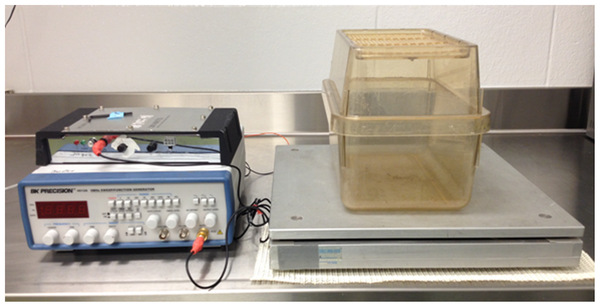
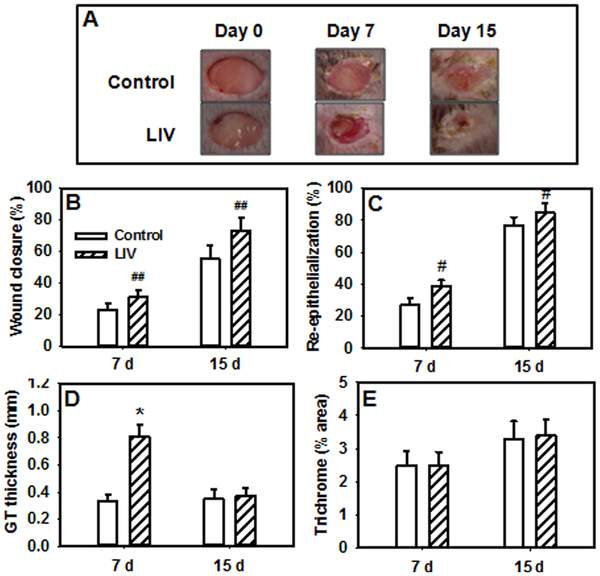
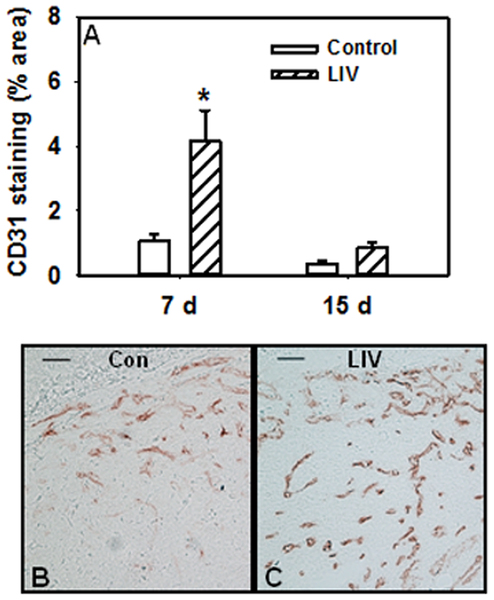
In a mouse model of type-2 diabetes (db/db mice), excisional skin wounds were subjected to low-magnitude, high-frequency mechanical vibration (0.4 g, 45 Hz) for 30 minutes per day, five days a week. Compared with sham-treated controls, vibrated wounds showed increased granulation tissue, enhanced angiogenesis, reduced neutrophil accumulation, increased macrophage presence, and higher levels of IGF-1, VEGF, and MCP-1. Wound closure and re-epithelialization were accelerated over 7-15 days. A related patent (US2013165824) describes a device and method for delivering such mechanical signals to tissue for therapeutic purposes, including weight control, metabolic improvement, and tissue repair.
Principles
- Low-intensity vibration
- Mechanotransduction
- Biomechanical stimulation of cellular pathways
Scientific Domains
Mechanisms of Action
- Mechanical stimulation of cells induces up-regulation of growth factors (IGF-1, VEGF)
- Promotion of angiogenesis and granulation tissue formation
- Modulation of immune cell infiltration (neutrophils, macrophages)
- Activation of mechanosensitive signaling pathways
Energy Sources
Applications
- Treatment of diabetic foot ulcers
- Accelerated wound healing in chronic wounds
- Bone health improvement
- Weight control and metabolic regulation
Claimed Performance
Wounds exposed to vibration healed more quickly than controls, with measurable increases in angiogenesis, granulation tissue, and growth-factor levels in diabetic mice.
Experimental Evidence
Mouse study (db/db diabetic mice) with LIV 0.4 g at 45 Hz, 30 min/day, 5 days/week showed increased angiogenesis, granulation tissue, and faster wound closure over 7-15 days compared to sham-treated mice.
Replication Status
No independent replication reported in the article.
Limitations
- Data limited to animal (mouse) studies
- Human clinical efficacy not yet demonstrated
- Optimal vibration parameters for humans remain to be defined
Red Flags
- Potential overstatement of translational potential without human trial data