Goal
Provide continuous, self-luminous lighting without external power, offering long-life, low-maintenance illumination that is safe, non-toxic, and durable.
Problem
Need for long-lasting, energy-free lighting that avoids the hazards of earlier radioactive paints (radium, gamma emitters) and overcomes light attenuation and degradation issues in self-luminous devices.
Concept Summary
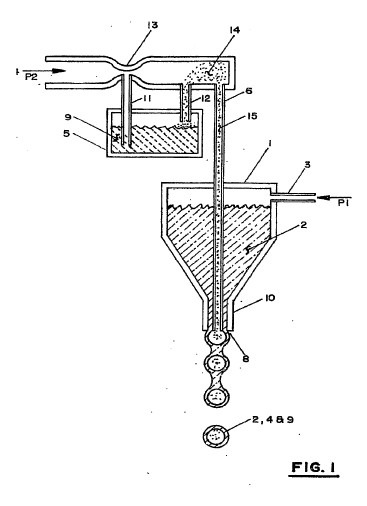
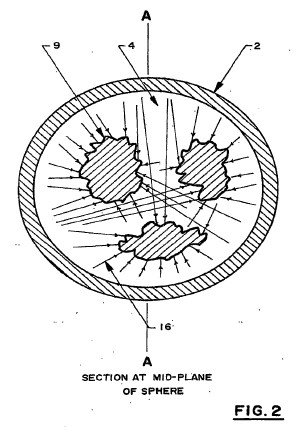
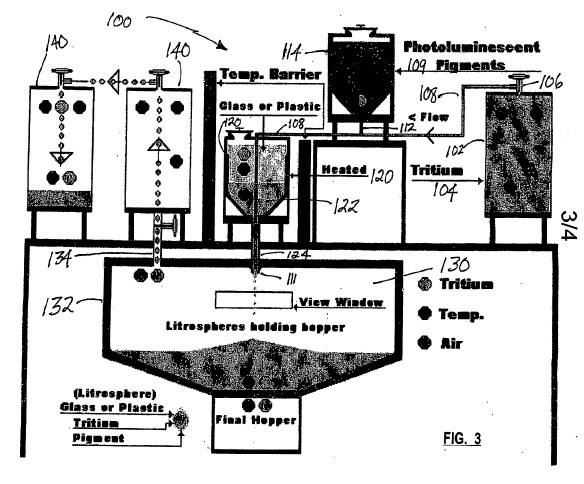
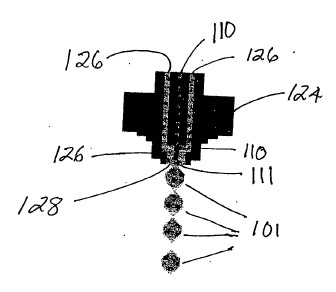
Microspheres composed of a glass or polymer shell encapsulating a beta-emitting radioactive gas (tritium) and a light-emitting phosphor. The beta particles excite the phosphor, producing visible light continuously for years. The spheres are crush-resistant, temperature-insensitive, can be mixed into paints or injection-molded, and emit no UV radiation.
Detailed Description
The invention uses borosilicate glass microspheres (or polymer equivalents) that contain tritium gas and a phosphor. Tritium's soft beta radiation cannot penetrate the sphere wall, eliminating external radiation hazards. The phosphor is fully surrounded by the gas, so emitted light does not pass through attenuating material. The spheres can be incorporated at about 20 % fill rate into paints or plastics, remain functional for a 12-year half-life (~=20 years usable), and resist crushing up to 5,000 lb. The technology can be combined with thin-film photovoltaics to create hybrid power cells that generate electricity from the emitted photons.
Principles
- radioluminescence
- beta decay excitation
- phosphor luminescence
- glass encapsulation
- non-toxic safety design
Scientific Domains
Materials
- borosilicate glass
- phosphor
- tritium gas
- polymer (optional)
Mechanisms of Action
- beta particle emission from tritium
- phosphor excitation by beta particles
- visible light emission
Energy Sources
Applications
- safety markings
- life rafts / flotation equipment
- toys
- sports and camping equipment
- bikes
- permanent lighting paint
- portable generators
Claimed Performance
Continuous illumination for 12+ years (half-life) with no external power; 20 % fill rate in paint or plastic; 5,000-lb crush resistance; non-toxic, no UV emission; can be combined with thin-film solar cells for hybrid power generation.
Experimental Evidence
MPK's in-house testing have been very encouraging; the microspheres won first place in NASA's Future Design contest; independent testing is scheduled but not yet reported.
Limitations
- radioactive material handling and regulatory approval
- gradual decrease in brightness over years
- limited power output for high-energy devices
- lack of independent peer-reviewed data
Red Flags
- Use of radioactive tritium in consumer-facing products
- Claims of free or continuous energy without external power
- Absence of independent, peer-reviewed performance data