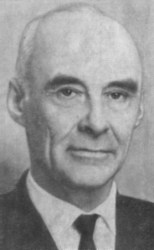
Goal
To investigate and experimentally study the properties of time and its causal/directive nature.
Problem
The lack of a physical framework that accounts for time asymmetry and its active role in causality.
Concept Summary
Kozyrev proposes that time possesses a quality that creates a difference between cause and effect, introducing a temporal asymmetry (directivity) into mechanics. He formulates axioms that cause and effect are separated in space (dx) and time (dt) with non-zero differences, leading to a finite ratio C_2 = dx/dt, contrasting with classical (dx!=0, dt=0) and atomic (dx=0, dt!=0) mechanics. The paper outlines possible experimental approaches to detect this time-directivity.
Principles
- Causality
- Temporal asymmetry
- Directivity of time
- Finite spacetime interval ratio (dx/dt)
Scientific Domains
Mechanisms of Action
- Axiomatic formulation of cause-effect separation in space and time
- Introduction of time as an active participant influencing system dynamics
Applications
- Fundamental physics research
- Cosmology
- Philosophy of time
Experimental Evidence
The quality and accuracy of conducted laboratory experiments do not allow drawing of specific conclusions about the nature of the effect.
Limitations
- No conclusive experimental data supporting the theory
- Experimental methods described are vague and unvalidated
- Theoretical assumptions not accepted by mainstream physics
Red Flags
- Claims lack peer-reviewed experimental validation
- Theory not based on accepted clearly formulated axiomatics
- Commission concluded laboratory experiments were insufficient