Goal
Provide a novel propulsion system for vehicles that converts motor power into forward motion via a rotating hemispherical contact wheel.
Problem
Need for a flexible, compact drive mechanism that can translate motor torque into vehicle motion without conventional wheels.
Concept Summary
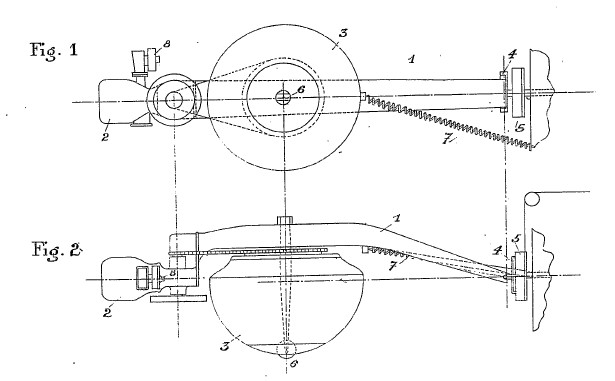
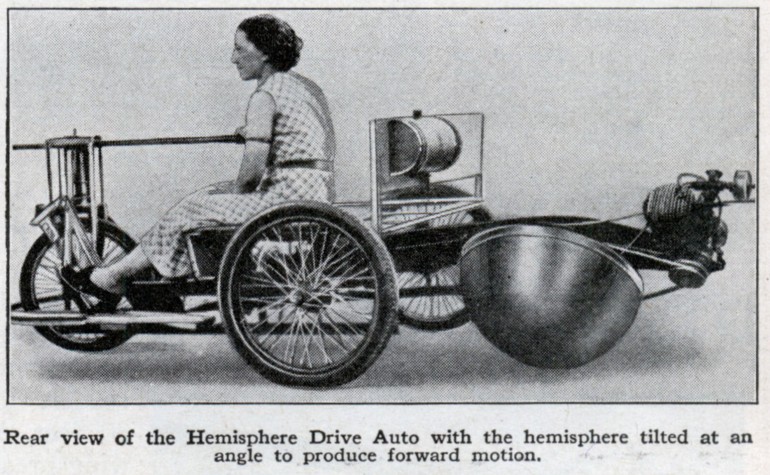
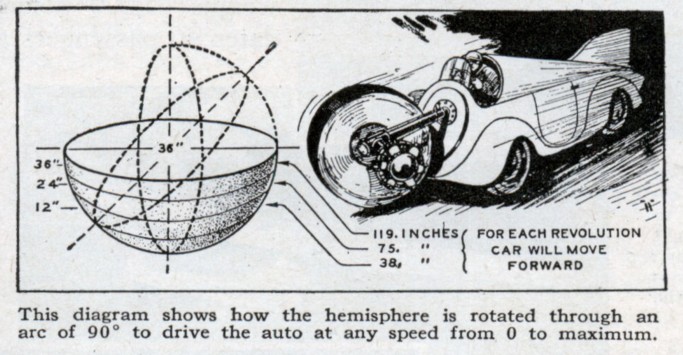
A motor drives a large hemispherical wheel that contacts the road. When the hemisphere is tilted, friction between the curved surface and the road generates forward thrust. The motor speed remains constant; acceleration is controlled by the tilt angle and the peripheral surface presented to the road. Steering is achieved with a separate lever that changes the hemisphere's orientation.
Detailed Description
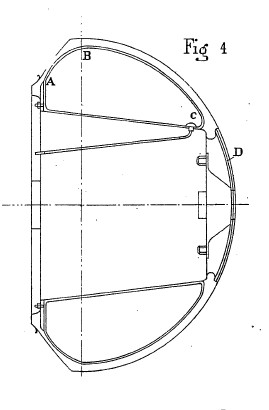
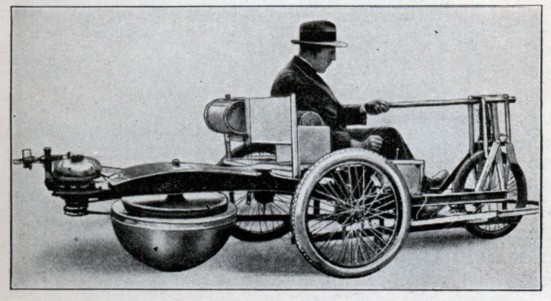
The system consists of a three-horsepower (or larger) motor mounted on a tricycle chassis. The motor's output shaft rotates a solid hemispherical element that rests on the road surface. In the neutral vertical position the hemisphere does not produce forward motion. By tilting the hemisphere slightly forward, the contact patch slides, and the frictional force propels the vehicle. A lever adjusts the tilt angle to control speed, while a second lever steers the vehicle by rotating the hemisphere about its vertical axis. The gyroscopic effect of the rotating motor and road irregularities influence stability and must be accounted for. Demonstrations at the 1938 Lepine Exhibition showed a top speed of 43 mph with a 3 hp motor; the inventor claimed that a 600 hp aircraft engine could achieve "incredible" speeds.
Principles
- Friction between a rotating hemispherical surface and the road
- Gyroscopic stabilization of the rotating motor
- Tilt-angle control of thrust
- Conversion of constant motor speed into variable vehicle speed
Scientific Domains
Materials
- Metal (likely steel or iron) for the hemisphere
- Standard automotive chassis materials
Mechanisms of Action
- Frictional drive
- Gyroscopic effect
- Angle-dependent thrust generation
Energy Sources
Applications
- Automotive propulsion
- Light-weight vehicle designs
- Experimental vehicle dynamics
Claimed Performance
Maximum speed of 43 mph with a 3 hp motor; potential for much higher speeds ("incredible") with a 600 hp aircraft engine.
Experimental Evidence
Demonstrated at the Lepine Exhibition (1938) with photographs showing the hemispherical drive in operation and a reported top speed of 43 mph.
Limitations
- Requires smooth road surface for effective friction
- Gyroscopic forces may affect handling on uneven terrain
- Limited scalability without addressing wear and material stress
- No quantitative efficiency data provided