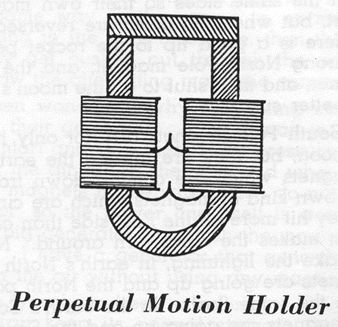
Goal
To demonstrate a perpetual-power magnetic current by circulating individual north- and south-pole magnetic particles and to use this phenomenon for energy generation.
Problem
The lack of a free or perpetual energy source and the inefficiencies of conventional electrical power generation.
Concept Summary
Leedskalnin proposes that permanent magnets contain a circulating 'substance' of tiny individual north- and south-pole magnets that can be guided into streams (magnetic currents). He claims that when opposite streams are forced to run against each other they produce continuous motion and can be harnessed for power. The article describes a series of hand-crafted experiments using steel fishing line, welding rods, Alnico and U-shaped magnets, copper wire, and a car battery to create and observe these magnetic streams.
Detailed Description
The author first explains his view of a magnet as a metal matrix through which microscopic north- and south-pole magnets circulate. He then outlines how to magnetize steel rods and fishing line by dragging strong permanent magnets over them, how to test polarity with iron filings, and how to arrange pairs of hanging magnets to observe attraction/repulsion when a current-carrying copper wire is heated by a car battery. He reports that the north-pole side of a magnet lifts more than the south-pole side on a tin strip, that the south end of a hanging rod is slightly longer, and that the magnetic currents cause hanging magnets to swing in opposite directions. He further claims that the battery's positive terminal emits north-pole magnetic currents and the negative terminal emits south-pole currents, and that these currents can be used to move other magnets or create "bubbles" of magnetic material.
Principles
- magnetic current
- circulation of individual magnetic poles
- screw-like opposite streams
- perpetual motion claim
Scientific Domains
Materials
- steel fishing line
- soft steel welding rod
- Alnico magnet
- U-shaped permanent magnet
- copper wire
- iron filings
- tin can
- glass
- wooden box
- lumber
Mechanisms of Action
- magnetic pole streams interacting
- magnetization of steel by external magnets
- thermal activation of copper wire by battery
Energy Sources
Applications
- alternative energy generation
- magnetic propulsion concepts
Claimed Performance
Magnetic currents possess perpetual power; the system can generate continuous motion without external energy beyond the initial battery heating.
Experimental Evidence
The author describes multiple hands-on experiments: (1) dragging a U-shaped magnet over a steel rod to magnetize it, (2) hanging magnetized rods and observing polarity with iron filings, (3) placing fishing-line magnets near a heated copper wire and noting swinging directions, (4) measuring slight length differences between north and south ends of a rod, (5) observing that north-pole magnets lift more on a tin strip while south-pole magnets push up more under a box of filings.
Limitations
- No quantitative measurements or independent verification
- Claims rely on qualitative observations only
- Lack of peer-reviewed scientific analysis
- Potential misunderstanding of conventional electromagnetism
Red Flags
- Perpetual-motion and free-energy claims without reproducible data
- Absence of accepted scientific terminology
- Reliance on anecdotal observations