Goal
Generate hydrogen fuel sustainably using only sunlight and wastewater while simultaneously treating the water.
Problem
Need for clean, renewable hydrogen energy and efficient wastewater treatment.
Concept Summary
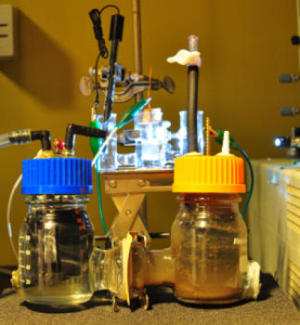
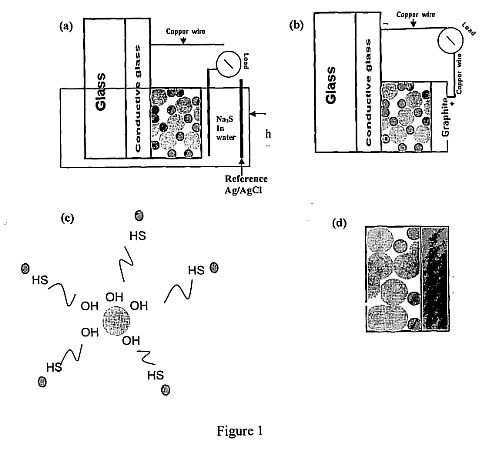
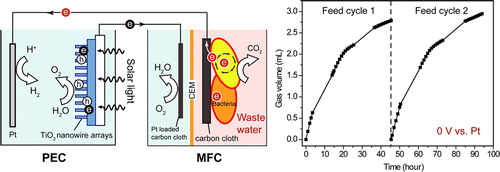
A hybrid system that couples a photoelectrochemical cell (TiO_2 nanowire photoanode + Pt cathode) with a microbial fuel cell. Sunlight creates a photovoltage that, together with electricity generated by electrogenic bacteria oxidizing organic matter in wastewater, drives water electrolysis without any external bias, producing hydrogen gas and treating the water.
Principles
- Photoelectrochemical water splitting
- Microbial electrogenesis
- Bio-battery voltage contribution
- Self-biasing electrolysis
Scientific Domains
Materials
- TiO_2 nanowire array (photoanode)
- Platinum cathode
- Electrode substrates (conductive glass, carbon)
- Electrogenic bacterial cultures (Shewanella oneidensis MR-1, mixed municipal microbes)
- Wastewater (organic substrate)
Mechanisms of Action
- TiO_2 nanowire photoanode generates ~0.7 V under AM1.5G illumination
- Electrogenic bacteria in the MFC oxidize organic matter, producing electrons and a bio-anode potential
- Combined voltage exceeds the thermodynamic barrier for proton reduction, driving water splitting at the Pt cathode
- Resulting hydrogen gas is collected; organic contaminants are consumed, lowering COD
Energy Sources
Applications
- Renewable hydrogen fuel production
- Municipal wastewater treatment
- Off-grid energy generation
Claimed Performance
Hydrogen production at an average rate of 0.05 m^3 day^-^1; soluble chemical oxygen demand (COD) reduced by 67 % over 48 h in laboratory tests.
Experimental Evidence
In laboratory tests with wastewater and solar simulation, the PEC-MFC continuously produced hydrogen at ~0.05 m^3 day^-^1 and reduced COD by 67 % over 48 h.
Replication Status
Proof-of-concept demonstrated at laboratory scale; a 40-liter prototype is planned but not yet reported.
Limitations
- Performance depends on wastewater composition and organic load
- Scaling from bench-scale to pilot-scale may encounter mass-transfer and bio-fouling issues
- Requires sufficient sunlight; performance may drop under cloudy conditions
- Long-term stability of the photoanode and microbial community not yet demonstrated