Goal
Automatically divert and store the cool water that would otherwise be wasted when hot water is drawn, reducing household water consumption.
Problem
Significant water wastage from the cold water that flows out of hot-water taps before the water heater delivers hot water.
Concept Summary
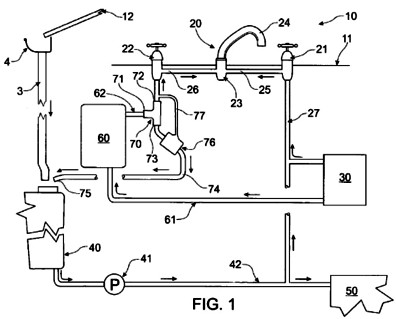
A thermal-sensing valve installed in the hot-water line detects the arrival of cold water and redirects it to a bypass line that feeds a storage tank. When hot water is needed, the valve returns the flow to the tap. A diaphragm valve closes the bypass when the tap is shut.
Principles
- Thermal detection of water temperature
- Valve actuation based on temperature trigger
- Bypass flow control
- Diaphragm valve closure
Scientific Domains
Materials
- Brass (valve body)
- Rubber/Elastomer (diaphragm)
- Thermal sensor element (metallic or ceramic)
Mechanisms of Action
- A thermal element senses when cold water is present in the hot-water line.
- A flow-control valve opens a bypass line, directing the cold water to a storage tank.
- When hot water reaches a preset temperature, the valve redirects flow back to the tap.
- A diaphragm valve in the bypass line closes the bypass when the hot-water tap is turned off.
Applications
- Residential water-conservation
- Rainwater-tank augmentation
Claimed Performance
Up to 40 L of water saved per day (~=16 000 L per year) for a typical three-person household.
Experimental Evidence
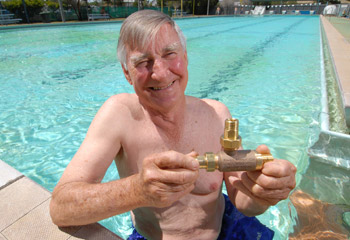
The device has been installed in homes and reported to save 40 L per day; it has been a weekly winner on ABC's New Inventors and is in commercial production.
Replication Status
Now in commercial production and available for installation in new or existing homes.
Limitations
- Requires installation in the hot-water pipe and a bypass line.
- May need a pressure-reducing valve and a storage tank for retro-fit installations.
- Savings depend on household hot-water usage patterns.