Goal
Increase propeller efficiency by generating thrust at the root, reducing tip drag, and improving cooling airflow.
Problem
Conventional propellers have inefficient lift distribution, high tip drag, and cause cooling airflow disturbances due to root geometry.
Concept Summary
A propeller designed as a rotating wing with an elliptical lift distribution, using a tapered planform, high root blade angle, laminar-flow cambered airfoils, and a very thin, low-drag tip to maximize thrust-to-power ratio and reduce drag.
Detailed Description
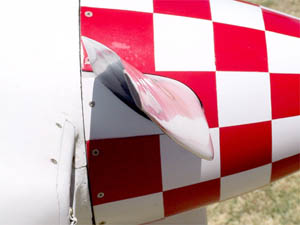
The ELIPPSE propeller employs a constant-lift planform that is modified by an elliptical coordinate transformation, resulting in a very wide root chord and a narrow tip. Blade twist is calculated from the helical path required for the design forward speed and rotational velocity, producing high angles at the root that still generate thrust. Laminar-flow airfoils with low drag coefficients are used, and the tip is shaped (slashed) to minimize drag and vortex formation. The prop is built from a laminated wood core over-coated with carbon-fiber or fiberglass, and is intended for light aircraft such as the Lancair 235.
Principles
- Elliptical lift distribution
- Laminar-flow airfoil performance
- Reynolds number effects on drag
- Helical blade twist calculation
- Thrust-to-torque ratio optimization
- Tip drag reduction via slashed tip geometry
Scientific Domains
Materials
- Carbon fiber
- Fiberglass
- Laminated wood core
Mechanisms of Action
- Variable chord distribution (wide root, narrow tip)
- High root blade angle to generate thrust
- Cambered laminar-flow airfoil to lower drag
- Thin, pointed tip to reduce tip drag and noise
- Blade twist matching helical flow for optimal angle of attack
Energy Sources
Applications
- Light aircraft propulsion
- Racing aircraft
- General aviation performance enhancement
Claimed Performance
Peak cruise efficiency of ~90 %, 15 % efficiency improvement over conventional props, 2 000 ft/min climb at 110 mph IAS, 240 mph at 5 500 ft, speed increase of 1-5 mph with tip modification.
Experimental Evidence
Flight tests on a Lancair 235 equipped with the ELIPPSE propeller showed measured speeds and climb rates within 5-10 % of the design predictions, and an efficiency gain of roughly 15 % compared to a conventional flat-bottom prop.
Replication Status
Tested on a single aircraft; no independent replication reported.
Limitations
- Complex blade geometry requires precise manufacturing
- Performance gains demonstrated only on a specific airframe
- Potential durability concerns for wooden core under high loads