Goal
Generate hydrogen gas from water cheaply and efficiently using an earth-abundant catalyst.
Problem
High cost and limited availability of platinum catalysts for water-splitting; need for carbon-neutral, low-cost hydrogen production.
Concept Summary
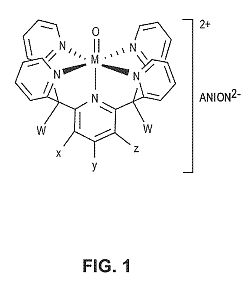
A molecular molybdenum-oxo complex (PY5Me2)Mo-oxo acts as a proton-reduction catalyst that operates in neutral, dirty, or seawater without organic additives, producing hydrogen with high turnover frequency under electrochemical or light-driven conditions.
Detailed Description
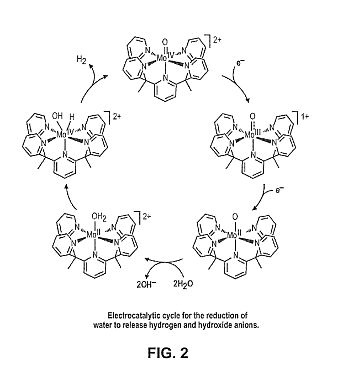
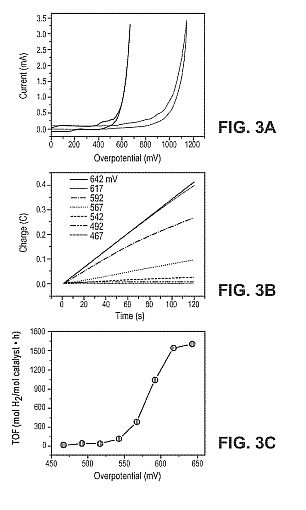
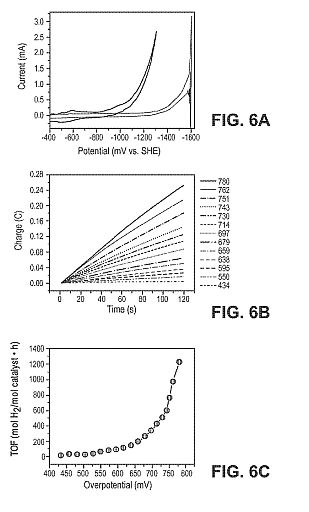
The invention describes a high-valence molybdenum-oxo complex, [(PY5Me2)MoO]^2^+ (often paired with PF_6^- counter-ions), which dissolves in aqueous media and catalyzes the reduction of protons to H_2. In laboratory tests the catalyst achieved a turnover frequency of 2.4 mol H_2 * mol catalyst^-^1 * s^-^1 in neutral buffered water and demonstrated activity in seawater. The catalytic cycle involves sequential electron transfers at a negative electrode (~= 1.0-1.4 V vs SHE) followed by proton uptake, releasing H_2. The ligand scaffold can be modified to tune activity, and the system can be driven electrically or by light.
Principles
- Catalysis
- Proton reduction
- Electrochemical water splitting
Scientific Domains
Materials
- Molybdenum
- Pyridine (PY5Me2 ligand)
- Hexafluorophosphate (PF_6^-)
- Sodium phosphate
- Potassium chloride
Mechanisms of Action
- Electron transfer to metal-oxo center
- Proton uptake and H_2 evolution
Energy Sources
Applications
- Hydrogen fuel cells
- Renewable energy storage
- Chemical feedstock production
Claimed Performance
Turnover frequency of 2.4 mol H_2 * mol catalyst^-^1 * s^-^1 in neutral buffered water; > 500 mol H_2 * mol catalyst^-^1 * s^-^1 reported for related persulfido complex.
Experimental Evidence
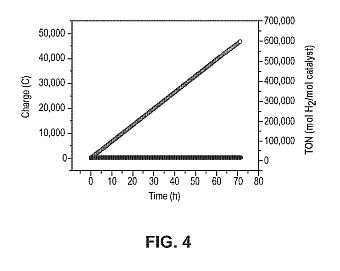
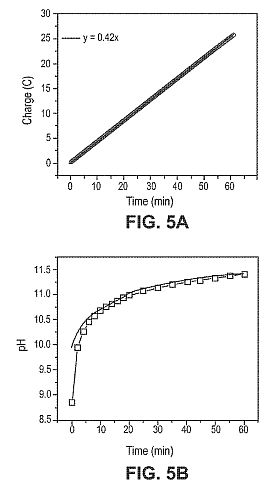
Laboratory electrochemical measurements showed the cited turnover frequencies and sustained H_2 evolution for at least three days in seawater.
Limitations
- Requires external electrical or light energy
- Long-term catalyst durability not fully demonstrated
Red Flags
- No independent replication reported in the article