Goal
Produce aneutronic nuclear power that is non-radioactive, non-proliferating and safe for civilian use.
Problem
Radioactive waste, nuclear proliferation, high cost and weight of conventional fission/fusion reactors, and the global energy crisis.
Concept Summary
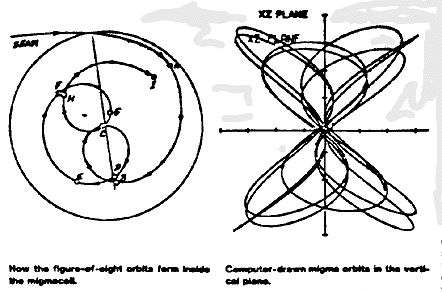
The Migma concept uses self-colliding particle orbits (a "mig-ma") to confine a high-energy deuteron beam. Oscillating electrons neutralize space-charge limits, allowing higher densities and temperatures than conventional tokamaks. Fusion products are primarily helium, yielding aneutronic energy. The device aims to reach break-even by increasing ion density with injected negative charge and to scale to megawatt-class power plants.
Principles
- Self-colliding particle orbits
- Space-charge neutralization by oscillating electrons
- Quadratic law of colliding-beam fusion rate
- Density increase via negative charge injection
Scientific Domains
Materials
- Deuterium (fuel)
- Lithium (light-metal fuel candidate)
Mechanisms of Action
- Beam-beam collisions in a closed orbit
- Electron oscillation to neutralize ion repulsion
- Negative charge injection to further increase ion density
Energy Sources
Applications
- Aerospace power (high power-to-weight ratio)
- Radar and telecommunications power supplies
- Naval propulsion and underwater power stations
- Utility-scale electricity generation
Claimed Performance
Migma IV demonstrated a confinement product 1,500x higher than tokamaks; goal to achieve break-even and produce >1 MW electric power from a 4-ft-diameter unit.
Experimental Evidence
Migma IV (1982) showed a 1-MeV deuteron migma could be neutralized by oscillating electrons, achieving temperatures 100x higher and confinement 15x longer than the best tokamak, despite a fuel density 1,000x lower.
Replication Status
Migma IV experiment performed by AELabs; subsequent tests (quadratic-law verification, density increase) are ongoing with no independent replication reported.
Limitations
- No peer-reviewed, independently verified data
- High development cost and long timeline
- Technical challenge of achieving break-even density
Red Flags
- Claims of break-even and megawatt output without independent verification
- Patent disputes and lack of US patent approval
- Heavy reliance on proprietary funding and limited public data