Goal
Convert heat and kinetic energy of a gas-vapor stream directly into electrical power without moving parts or magnetic fields.
Problem
Low efficiency of conventional thermal generators and waste of heat energy from furnaces and other sources.
Concept Summary
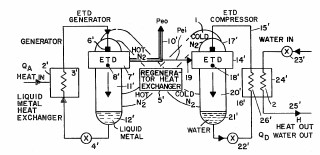
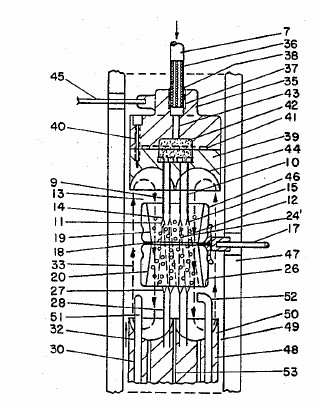
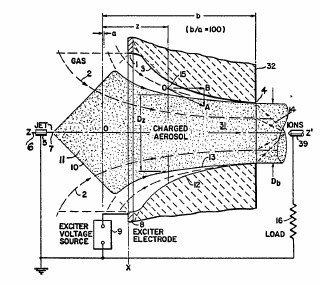
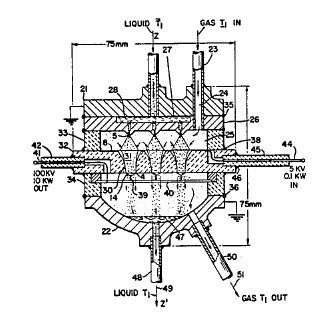
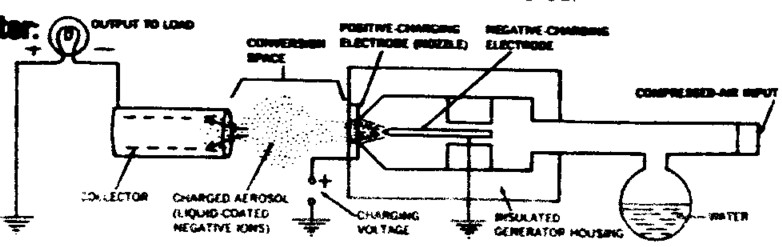
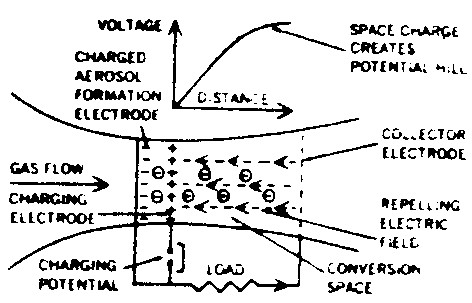
A jet of gas containing liquid vapor is passed through an electric field that charges the vapor droplets, creating a fine aerosol of charged particles. The kinetic and thermal energy of the expanding gas drives the aerosol toward a collector electrode, where the charge is transferred to an external circuit, producing DC electricity. Space-charge repulsion and nozzle pressure are used to increase the electrical potential.
Detailed Description
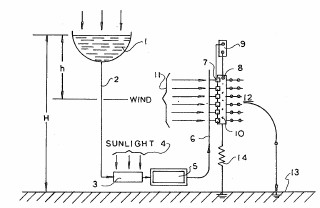
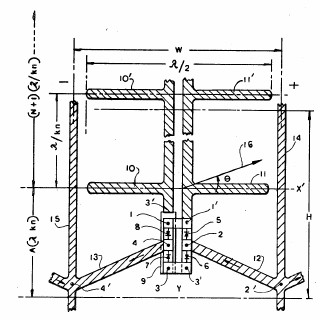
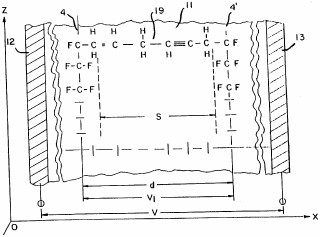
The generator consists of a spike-shaped negative electrode and a positive nozzle that establish an electric field. Water vapor in the gas stream condenses into droplets that become charged (anions) within the field. The expanding gas carries the charged aerosol through a conversion space to a collector electrode. As droplets deposit, they release their charge, delivering a DC voltage (up to 50 kV) and current (~=200 uA in the laboratory model). Increasing nozzle pressure by adding heat raises the voltage and current. A full-scale prototype built under a government contract is reported to be capable of 1-10 kW output.
Principles
- Electrostatic charging of aerosol droplets
- Thermal-to-electric energy conversion
- Space-charge repulsion
- Pressure-driven gas flow
Scientific Domains
Materials
- Water (vapor and liquid droplets)
- Air or helium (carrier gas)
- Metal electrodes (e.g., copper, steel)
- Collector electrode (metal)
Mechanisms of Action
- Ionization of vapor molecules in an electric field
- Condensation of charged droplets
- Charge transport by aerosol flow
- Charge collection on an electrode
Energy Sources
Applications
- Home power generation from waste heat
- Industrial waste-heat recovery
- Combined heat and power (CHP) systems
- Storm-energy harvesting
Claimed Performance
Conversion efficiency up to 70 %; model output ~=10 W (50 kV x 200 uA); full-scale prototype projected 1-10 kW, aiming for 10 kW.
Experimental Evidence
Laboratory model produced 50 kV DC at 200 uA (~=10 W). A full-size generator built under a government contract is being tested at Marks Polarized Corp.
Replication Status
Prototype built and tested under government contract; no independent replication reported.
Limitations
- Requires a continuous heat source to maintain gas pressure
- Space-charge buildup can limit scalability
- Efficiency claims lack independent verification
- High voltage handling may pose safety challenges
Red Flags
- No peer-reviewed data or independent replication
- Efficient efficiency claims (up to 70 %) without detailed measurements
- Reliance on vague statements such as "something for nothing"
- Potential overstating of commercial readiness