Goal
Convert sunlight into usable heat for space heating using a low-cost, recyclable collector.
Problem
Need for affordable, efficient solar thermal air heating systems that can be built from readily available materials.
Concept Summary
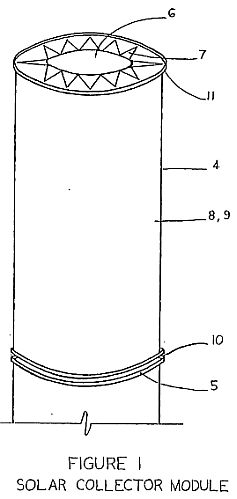
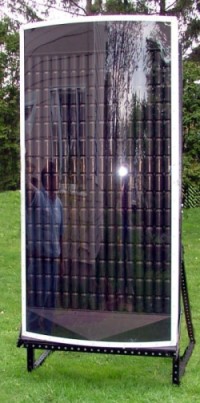
A modular solar air heater built from recycled soda cans coated with black paint, assembled into tubular columns that pass air (forced or natural convection) through them. Turbulent flow created by a fin/fan at the top of each module enhances heat transfer, producing hot air for space heating.
Detailed Description
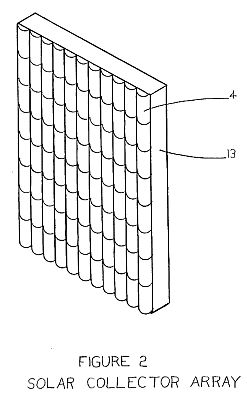
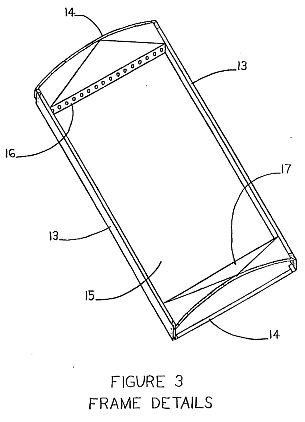
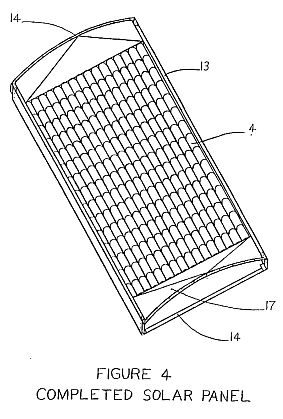
The invention consists of a frame supporting multiple solar collector modules made from thin aluminium (often recycled soda cans) painted with a high-solar-absorbent black coating and bonded with silicone glue. Each module has a bottom opening and a smaller top opening fitted with a fin or fan to create turbulent airflow. Modules are stacked longitudinally to form columns; several columns are arranged into an array behind a transparent cover (glass or plastic). Air passes through the columns either by natural convection or by a forced-air fan, absorbing heat from the solar-heated aluminium surfaces. The system can be roof-mounted or placed on a south-facing wall. Reported performance includes a temperature rise of 10-12 deg C and a thermal output of 9 000-9 720 BTU h^-^1 (~=2.6-2.8 kW) under peak conditions.
Principles
- Solar radiation absorption
- Thermal convection
- Turbulent airflow for enhanced heat transfer
- Black-body emissivity
Scientific Domains
Materials
- Aluminium (recycled soda cans)
- High-solar-absorbent black paint
- Silicon adhesive
- Transparent glass or plastic sheet
Mechanisms of Action
- Absorption of solar photons by black-painted aluminium surfaces
- Conversion of absorbed radiation to heat
- Air flow through heated columns transfers heat to the a stream
- Turbulence created by fin/fan increases convective heat transfer coefficient
Energy Sources
Applications
- Residential space heating
- Greenhouse heating
- Water pre-heating
Claimed Performance
Efficiency rating 67 %-95 %; power coefficient 1-77 (one watt of solar input yields up to 77 W of heat); peak output 9 000-9 720 BTU h^-^1 (~=2 636-2 847 W) with a temperature rise of 10-12 deg C.
Experimental Evidence
Peak BTU performance observed during the noon hour period in October 2001 wherein the temperature rise was 10-12 deg C (50-54 deg F) resulting in a 9 000-9 720 BTU or 2636-2847 W output. Independent engineers reported a power coefficient of 1-77.
Limitations
- Performance varies with solar incidence angle and irradiance
- Requires adequate airflow (forced or natural)
- Durability of recycled cans over long term unknown
- Limited to locations with sufficient sunlight