Goal
Provide high-speed aircraft propulsion capable of operating at stratospheric altitudes where conventional propellers lose effectiveness.
Problem
Insufficient thrust from propellers in thin upper-atmosphere air and the need for a lightweight, reliable power plant without heavy mechanical compressors.
Concept Summary
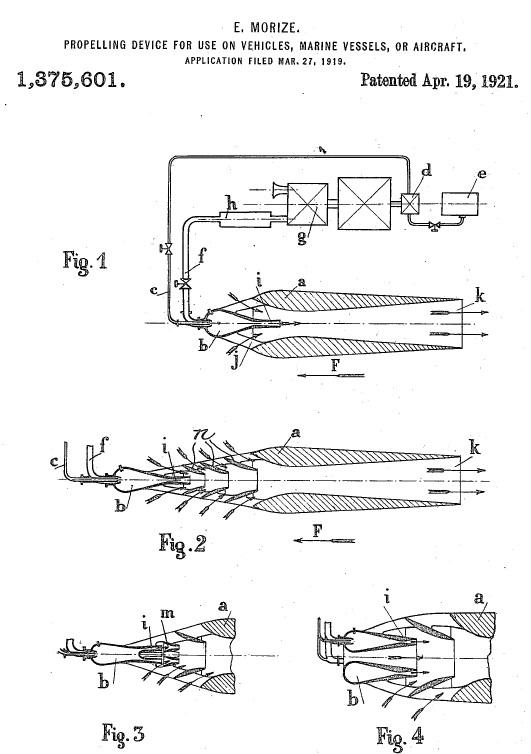
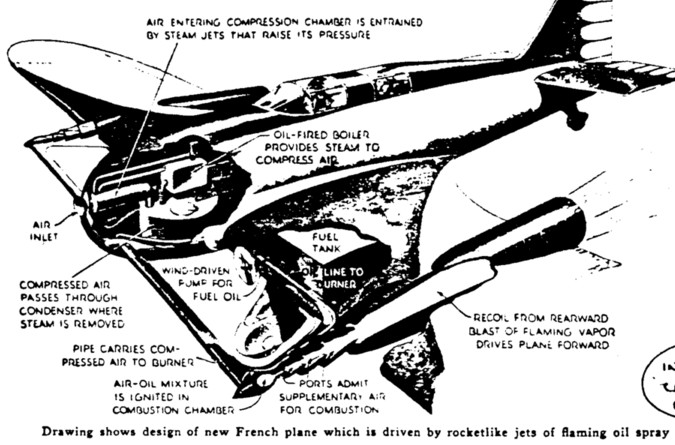
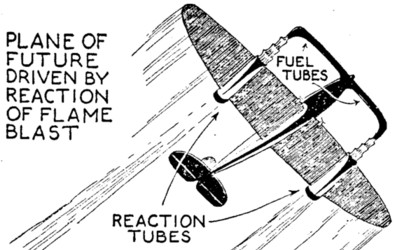
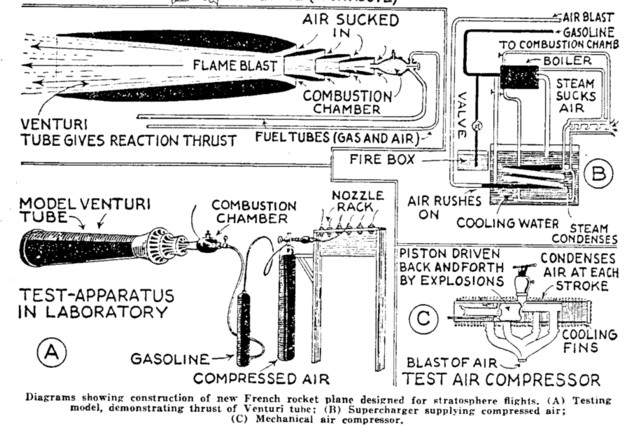
A rocket-like airplane uses a mixture of fuel oil and compressed air ignited in blast nozzles. High-pressure air is supplied not by a mechanical compressor but by a steam-driven injector that entrains ambient air. The resulting high-velocity flame jet and ejector tubes generate forward thrust with virtually no moving parts.
Detailed Description
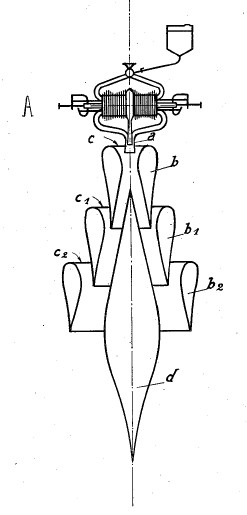
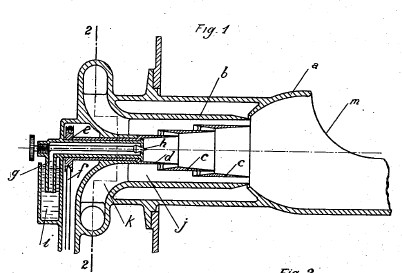
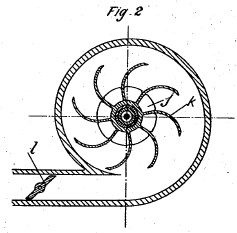
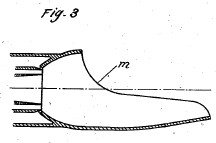
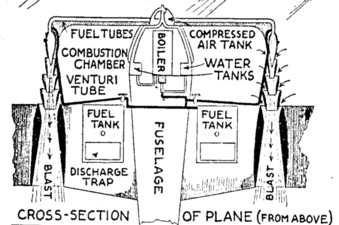
The system consists of an oil-fired boiler that produces a high-pressure steam jet. This steam passes through a series of injector holes, entraining outside air and delivering a mixture of steam-air to a cooling coil where the steam condenses, leaving dry high-pressure air. The air is then mixed with fuel oil in a combustion chamber and ignited, producing a flame-blast that exits through venturi-shaped ejector tubes. The venturi geometry creates a partial vacuum that draws additional air forward, increasing the mass flow and thus the forward thrust. Several ejector tubes are arranged in series, the first being longer to allow proper expansion of the high-speed mixture. The design eliminates conventional pistons, crankshafts, and compressors, relying on steam-driven air entrainment and the ejector principle for thrust generation.
Principles
- Thermodynamics
- Fluid dynamics
- Ejector principle
- Venturi effect
- Combustion
Scientific Domains
Materials
- Fuel oil
- Water / steam
- Air
- Metal (boiler, tubes, nozzles)
Mechanisms of Action
- Combustion of fuel oil with compressed air
- Steam-driven air entrainment via injector
- Ejector thrust generation using venturi tubes
- Partial vacuum suction to increase mass flow
Energy Sources
Applications
- Aircraft propulsion
- High-altitude reconnaissance
- Potential marine or terrestrial thrust devices
Claimed Performance
Speeds of 600 mi/h, with a possible future capability of 900 mi/h; trans-Atlantic crossing in ~4 hours.
Experimental Evidence
Laboratory tests of the Venturi-type ejector tube were performed and reported to support the claimed thrust, but no quantitative data or independent replication were provided.
Limitations
- Heavy water/steam boiler required
- No flight-tested prototype documented
- Efficiency and fuel consumption not quantified
- Complex steam-air entrainment may be sensitive to altitude
Red Flags
- Performance claims lack quantitative validation
- Reliance on steam boiler adds weight and complexity
- No independent replication or peer-reviewed data