Goal
Provide a light bulb filament that is stronger, more durable, and more energy-efficient than conventional tungsten filaments.
Problem
Conventional tungsten filaments become brittle at high temperature, have low emissivity, require long coiled lengths, and consume relatively high electrical power.
Concept Summary
A single-crystal whisker made of beta-silicon carbide (SiC) doped with nitrogen serves as the filament. The whisker's high emissivity (~0.9), high mechanical strength, and relatively stable resistance with temperature enable incandescent operation at lower power consumption.
Detailed Description
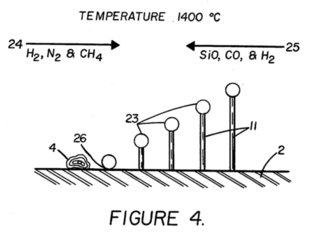
The invention uses monocrystalline beta-SiC fibers (~=5 um diameter, 3-30 mm length) doped with nitrogen to achieve sufficient electrical conductivity. The whiskers are mounted between contacts and powered with DC voltage, producing incandescence at 800-1440 deg C. Comparative tests with tungsten filaments show higher emissivity and lower power draw for comparable light output.
Principles
- High emissivity ceramic material
- Nitrogen doping to adjust electrical conductivity
- Monocrystalline whisker geometry for high strength and surface-to-volume ratio
Scientific Domains
Materials
- beta silicon carbide (SiC)
- nitrogen (dopant)
Mechanisms of Action
- Electrical resistance heating
- Incandescence
- Enhanced radiative efficiency due to high surface-to-volume ratio
Energy Sources
Applications
- Household incandescent lighting
- High-temperature industrial lighting
Claimed Performance
Emissivity ~0.9 (vs ~0.4 for tungsten), lower power consumption at incandescent temperatures, operation up to 1440 deg C in partial vacuum, high mechanical strength and durability.
Experimental Evidence
A demonstration used 30 V DC on nitrogen-doped beta-SiC whiskers (5 um x 3-30 mm) causing red glow (800-1000 deg C). In partial vacuum temperatures of 1100-1440 deg C were reached before burnout. Comparative tables show lower resistance and higher emissivity versus tungsten filaments.
Replication Status
No independent replication reported; performance data are limited to the inventor's own laboratory tests.
Limitations
- Oxidation and burnout in air at high temperature
- Requires vacuum or inert atmosphere for highest temperature operation
- Manufacturing of uniform single-crystal SiC whiskers can be costly
Red Flags
- Performance claims rely on limited laboratory data without peer-reviewed validation