Goal
Provide a low-cost, high-performance energy-storage device that can replace expensive graphene electrodes in supercapacitors.
Problem
The high price and limited scalability of graphene-based electrodes for high-power energy storage.
Concept Summary
Waste hemp bast fibers are hydrothermally carbonized and chemically activated to produce porous carbon nanosheets that mimic graphene. These nanosheets are used as electrodes in a supercapacitor with an ionic-liquid electrolyte, delivering high power and energy densities at a fraction of the cost of graphene.
Detailed Description
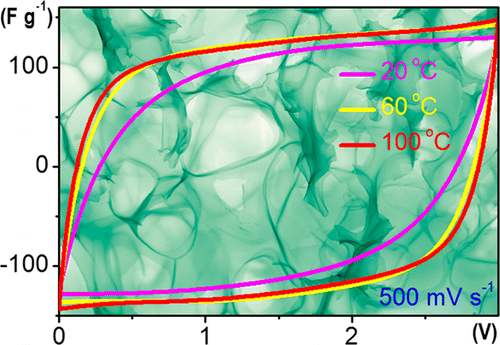
The process begins with hemp bast (inner bark) that is heated at ~180 deg C for 24 h to dissolve lignin and hemicellulose, leaving a carbonized matrix. The material is then treated with potassium hydroxide and heated to 700-800 deg C, causing exfoliation into porous carbon nanosheets (2-5 nm pores). The nanosheets are fabricated into electrodes and combined with an ionic liquid electrolyte to assemble a supercapacitor. Laboratory tests show operation from -0 deg C to 100 deg C, power densities up to 49 kW kg^-^1 at 60 deg C, and energy densities of 19-40 Wh kg^-^1 depending on temperature, with a full-device energy density of 12 Wh kg^-^1 and charge times under six seconds.
Principles
- Hydrothermal carbonization
- Chemical activation (KOH)
- Electrical double-layer capacitance
- High-surface-area porous carbon electrodes
Scientific Domains
Materials
- Hemp bast fiber (lignin, hemicellulose, cellulose)
- Carbon nanosheets (derived from hemp)
- Potassium hydroxide (KOH)
- Ionic liquid electrolyte
Mechanisms of Action
- Ion adsorption/desorption on porous carbon surfaces
- Rapid charge transfer through high-conductivity carbon nanosheets
Energy Sources
Applications
- Electric vehicles (regenerative braking)
- Power-tool electronics
- Oil-and-gas industry equipment (high-temperature operation)
- Portable high-power devices
Claimed Performance
Power density up to 49 kW kg^-^1 at 60 deg C; energy density 19-40 Wh kg^-^1 (20-100 deg C); full device energy density 12 Wh kg^-^1 with charge time <6 s.
Experimental Evidence
Peer-reviewed ACS Nano paper (2013) reports the performance metrics; Chemical & Engineering News article (May 15 2013) describes the synthesis and testing; data tables quoted in the article.
Limitations
- High-temperature (700-800 deg C) activation step may be costly at scale
- Reliance on ionic-liquid electrolytes, which can be expensive
- Long-term cycle life not yet demonstrated
- Scaling from lab-scale to commercial production not proven