Goal
Produce hydrogen gas with high efficiency by directly pyrolyzing water using plasma generated in an aqueous solution.
Problem
Low efficiency and high temperature requirements of conventional water electrolysis and pyrolysis for hydrogen production.
Concept Summary
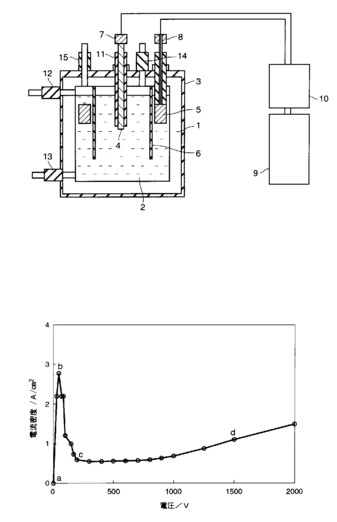
A high-voltage electric discharge creates a plasma sheath on a metal electrode immersed in a heated aqueous solution. The plasma raises the local temperature to several thousand degrees, enabling direct water decomposition (pyrolysis) and producing hydrogen (and oxygen) at rates far exceeding those of ordinary electrolysis.
Detailed Description
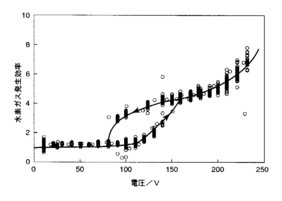
The method involves heating an aqueous solution (acid, alkali, or metal salt) to 70-100 deg C, then applying a pulsed voltage of 100-2000 V with pulse widths of 0.1-10 s and intervals of 0.01-5 s. The high electric field initiates plasma formation at the cathode surface. The plasma generates extreme local temperatures (>4000 deg C) that dissociate water molecules directly, yielding hydrogen gas at the cathode and oxygen at the anode. Measured heat output can exceed the electrical input by up to 200 %, and hydrogen production was observed to be up to 80 times greater than conventional electrolysis at 300 V.
Principles
- Plasma formation at electrode surface
- Faraday's law of electrolysis
- High-temperature water pyrolysis
- Pulsed high-voltage discharge
Scientific Domains
Materials
- Water
- Acid (e.g., H_2SO_4)
- Alkali (e.g., NaOH)
- Metal salts
- Metal electrode (cathode)
Mechanisms of Action
- Electrical breakdown of liquid to create plasma
- Localized heating to >4000 deg C
- Direct dissociation of H_2O into H_2 and O_2
- Enhanced hydrogen evolution beyond Faraday efficiency
Energy Sources
Applications
- Hydrogen fuel production
- Energy storage
- Industrial hydrogen supply
Claimed Performance
Hydrogen generation up to 80x that of conventional electrolysis at 300 V; heat output up to 200 % of the electrical input power.
Experimental Evidence
Authors reported observed increases in hydrogen production and measured heat exceeding input power; reproducibility claimed at 100 % when temperature, voltage, and duration are optimized.
Replication Status
Authors state that reproducibility would be 100 % under optimized conditions; no independent replication reported.
Limitations
- Requires high voltage (up to 2000 V)
- Precise temperature and pulse control needed
- Potential electrode erosion
- Scalability not demonstrated
Red Flags
- Claims of heat output exceeding electrical input without independent verification
- High voltage operation may pose safety and regulatory challenges