Goal
Remote ignition of explosives at a distance without wires or direct contact.
Problem
Need for a defense weapon that can detonate enemy ammunition from afar, eliminating the need for direct contact or wiring.
Concept Summary
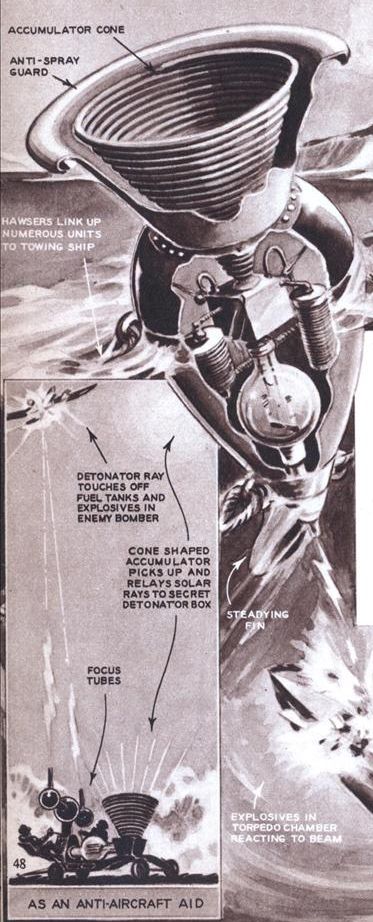
The Solar Mohr Detonator uses a cone-shaped antenna to collect solar energy (described as the sun's magnetic force) and converts it into synchronized vibratory currents. These currents are tuned to the atomic vibration frequencies of an explosive material and transmitted as a focused beam. When the beam reaches the target explosive, friction heating causes the material to ignite, resulting in detonation.
Detailed Description
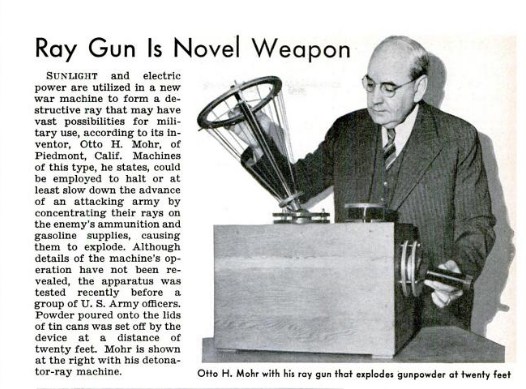
A cubical device about two feet on a side holds a cone-shaped antenna topped with a metal tube that must be pointed at the sun. A gentle buzz indicates correct alignment, after which a dim light appears in a forward-facing tube. The operator points this tube at the target explosive. The solar energy collected by the antenna is transformed into high-frequency vibrations that are resonant with the target's atomic structure. The resonant beam induces frictional heating in the explosive, causing it to ignite. Demonstrations showed a powder charge exploding after nine minutes of exposure. The inventor claims the range can be extended to about forty miles with sufficient solar energy, and that a mercury-arc lamp could substitute for sunlight at night.
Principles
- Solar radiation collection
- Magnetic field conversion to vibratory currents
- Resonant frequency tuning to explosive atoms
- Frictional heating
- Beam focusing
Scientific Domains
Materials
- Potassium nitrate
- Sulfur
- Charcoal
- Hydrocarbon explosives
- Metal tube (antenna core)
- Lens or focusing tube (implied)
Mechanisms of Action
- Solar energy gathered by a cone antenna
- Conversion of solar magnetic force into synchronized vibrations
- Tuning of vibrations to match atomic vibrations of the explosive
- Transmission of resonant beam to target
- Friction heating leading to combustion
Energy Sources
Applications
- Military defense
- Remote demolition
- Anti-ship/anti-aircraft weapons
Claimed Performance
Explodes a one-pound powder charge placed 20 ft away after nine minutes; potential range up to ~40 miles with sufficient solar energy.
Experimental Evidence
The article describes a test where canvas bags of powder were placed in a field, the device was aimed, and the powder exploded nine minutes later. Army officials observed the demonstration and recommended favorable consideration.
Replication Status
Demonstrated to United States Army officials; no independent replication reported.
Limitations
- Requires sunlight (or artificial light source)
- Effective only when atomic vibration frequencies of the explosive are known
- Current demonstrated range limited to tens of feet
- Device dismantled after each demonstration, limiting continuous use
- No proven night-time operation without additional light source
Red Flags
- Vague description of 'sun's magnetic force' without scientific backing
- Lack of quantitative data or peer-reviewed studies
- Extraordinary claim of remote detonation using only sunlight
- No independent replication or modern verification