Goal
Generate electrical power without using any fuel.
Problem
Reliance on fossil fuels and associated pollution; need for a self-sustaining power source.
Concept Summary
The LEM3 Power Unit is claimed to produce continuous electrical power after an initial battery start-up by using a junction of lead-iron sulfide (Pb-FeS) in a magnetic field. The device allegedly exploits gyroscopic particles orbiting in the magnetic field to generate electricity, which can then drive hydraulic pressure and a propeller for aircraft propulsion.
Detailed Description
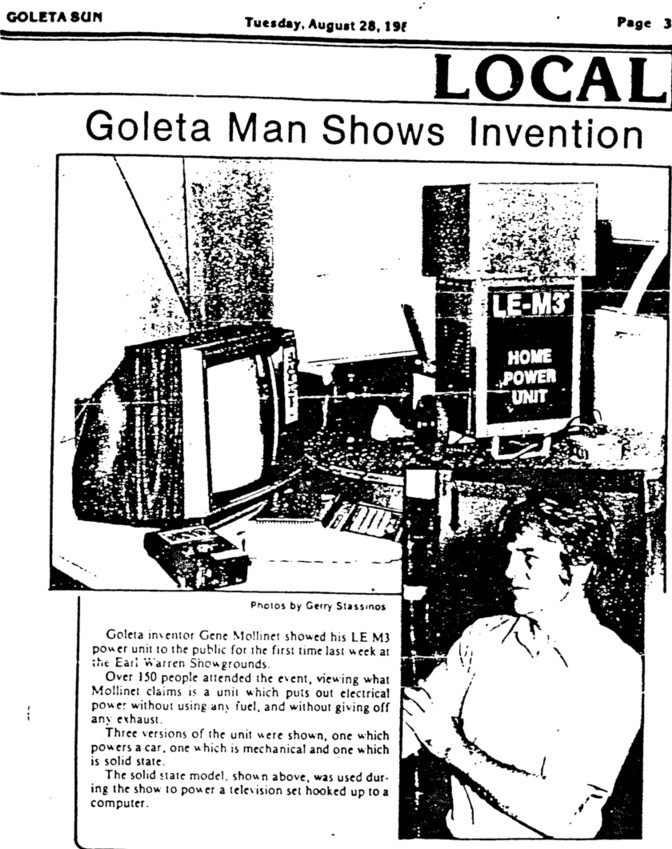
Gene Mollinet's prototype consists of a small metal box (the LEM3) that is initially connected to a regular car battery. After the battery is disconnected, the unit continues to operate, powering a television, a car, and a mechanical generator demonstrated at a public show. The core of the device is described as a Pb-FeS crystal junction placed within a magnetic field; the magnetic field together with "gyroscopic particles" is said to produce electricity. In the aircraft version, the generated electricity is used to build hydraulic pressure that turns a propeller. Mollinet plans to install the unit in a Cessna 152 and fly around the world for five days without fuel. The invention is patented pending and a corporation (LEM3 Development Corp.) was formed in 1982.
Principles
- Magnetic field induction
- Gyroscopic particle motion
- Crystal energy storage (Pb-FeS junction)
- Hydraulic pressure conversion
Scientific Domains
Materials
- Lead-iron sulfide (Pb-FeS) crystal
- Standard car battery
- Hydraulic fluid
- Water (for crew consumption)
- Metal housing
Mechanisms of Action
- Interaction of magnetic field with Pb-FeS crystal junction
- Orbiting gyroscopic particles generating charge separation
- Conversion of electrical energy to hydraulic pressure for propulsion
Energy Sources
Applications
- Aircraft propulsion
- Vehicle power
- Home electricity generation
Claimed Performance
Continuous operation without fuel; capable of powering a television, a car, a mechanical generator, and a small aircraft for a five-day world flight.
Experimental Evidence
The unit was demonstrated at the Earl Warren Showgrounds, powering a television set and a car while attended by 125-150 people. A solid-state model was used to power a TV and a computer during the show.
Replication Status
No independent replication reported; only the inventor's own prototypes have been shown.
Limitations
- No peer-reviewed data
- Physics not explained in conventional terms
- Scalability unproven
- Reliance on unverified magnetic/crystal effect
Red Flags
- Extraordinary claim of free energy
- Lack of quantitative performance data
- No independent verification
- Potential for fraud or misinterpretation