Confidence
0.95
Practicability
0.90
Evidence
0.60
Fringe Score
0.10
Risk
0.10
TRL
6
Goal
Capture flies that transmit trachoma, thereby reducing the incidence of trachoma-related blindness.
Problem
Flies act as mechanical vectors for the bacterium that causes trachoma, a leading preventable cause of blindness in developing countries.
Concept Summary
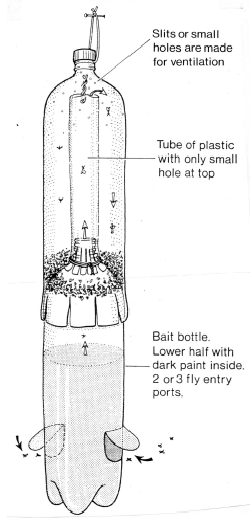
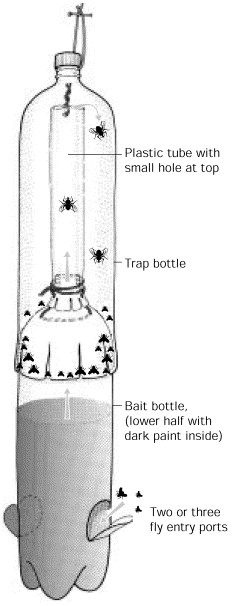
A low-cost trap built from two clear plastic bottles, a darkened bait bottle (filled with goat dung, cow urine, yeast, etc.) and a transparent trap bottle that uses upward light attraction and UV exposure to draw flies in and kill them.
Principles
- Phototaxis - flies move upward toward light
- Attraction to organic bait (feces, urine, yeast)
- UV-induced mortality
Scientific Domains
Materials
- Transparent plastic bottles (pop bottles)
- Black or dark paint
- Goat dung
- Cow urine
- Yeast
- Ammonium carbonate
Mechanisms of Action
- Bait emits odors that attract flies
- Flies enter dark bait bottle, then move upward toward light in the second bottle
- Exposure to UV light and exhaustion kills the flies
Energy Sources
Applications
- Disease-vector control
- Rural public-health programs
- Community-based sanitation
Claimed Performance
Field trial in 300 Masai homes showed a ~40 % reduction in indoor fly numbers and >30 % drop in trachoma cases.
Experimental Evidence
A one-year trial in 300 Kenyan households reported the reductions above.
Replication Status
Trial conducted; no further commercial scaling reported.
Limitations
- Effectiveness depends on regular bait replacement
- Requires access to suitable plastic bottles and organic waste
- UV exposure may be limited in cloudy environments