Goal
To exploit ferromagnetic resonance and tetrahedral lattice effects to amplify electromagnetic signals, convert ambient background radiation into usable electrical energy, and achieve measurable weight-loss or gravity-cancellation effects.
Problem
Low-energy density of ambient electromagnetic/background radiation and the lack of efficient conversion mechanisms for harvesting that energy.
Concept Summary
The authors describe a circuit (the Nieper Ring) that, when driven near its free-oscillation frequency (~1.1-1.3 MHz), exhibits frequency multiplication, large voltage amplification, and a small but measurable loss of weight in the apparatus. They link these phenomena to ferromagnetic resonance around 170-175 kHz, tetrahedral lattice resonance of silicon transistors, and hypothesize a coupling to the Earth's magnetic field that could produce gravity-cancellation or zero-point-energy (ZPE) extraction.
Detailed Description
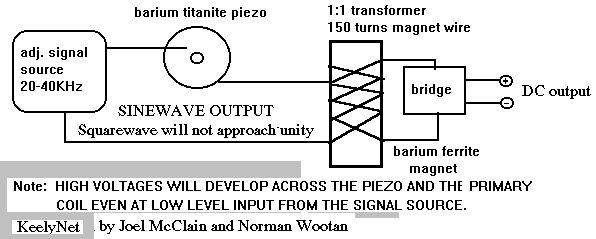
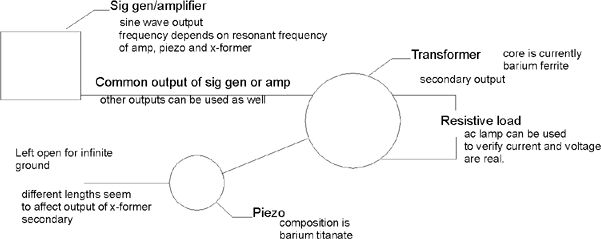
Experiments involve placing piezoelectric transducers (barium titanate) on CB antennas, coupling them to square-wave generators, and observing frequency multiplication (e.g., 7.48 kHz -> 37.43 kHz) and voltage rise to 400 V. Ferromagnetic resonance is probed using a Nieper Ring circuit, a tetrahedron-shaped coil (TET) wound with silver-coated wire, and magnets (neodymium, alnico, barium ferrite). The circuit reportedly loses ~350 mg of weight after 15-20 min of operation, which the authors attribute to a resonant tetrahedral lattice effect in the silicon transistors. They also discuss scaling the effect to a "Sparky Sweet" coil for gravity cancellation and a ZPE generator.
Principles
- Ferromagnetic resonance
- Tetrahedral lattice resonance
- Frequency multiplication
- Electromechanical coupling in transistors
- Magnetic flux cancellation
Scientific Domains
Materials
- Piezoelectric ceramic (barium titanate)
- Neodymium magnet
- Alnico magnet
- Barium ferrite magnet
- Silver-coated copper wire
- Audio TO-3 transistors
- Nieper Ring circuit components
Mechanisms of Action
- Resonant coupling of piezoelectric transducers with ferromagnetic materials
- Free oscillation of a transistor-based circuit at MHz frequencies
- Magnetic flux shaping by a tetrahedral coil geometry
Energy Sources
Applications
- Energy harvesting from ambient radiation
- Gravity research / weight-loss devices
- Experimental ZPE generation
Claimed Performance
Frequency multiplication by factor 5x, voltage increase from millivolts to 400 V, weight reduction of ~350 mg after 15-20 min of operation.
Experimental Evidence
Observed 8 V peak at 7.48 kHz, 400 V at 37.43 kHz; frequency lock at 174.8 kHz (ferromagnetic resonance) and 349.85 kHz (one octave higher); weight loss measured 350 mg over ~15 min.
Replication Status
Only reported by the authors; no independent verification or peer-reviewed replication documented.
Limitations
- Lack of independent replication
- Measurements are anecdotal and lack quantitative controls
- Possible thermal effects conflated with weight loss
Red Flags
- Claims of gravity cancellation and ZPE extraction without peer-reviewed evidence
- Use of over-driven audio transistors far beyond their specified frequency range
- Weight-loss measurement could be due to heating or buoyancy rather than a novel physics effect