Goal
Achieve ultra-high electrical conversion efficiency by reducing Lenz-law back-torque resistance in generators/motors.
Problem
Conventional generators suffer from Lenz-law induced back torque (back EMF) that limits efficiency.
Concept Summary
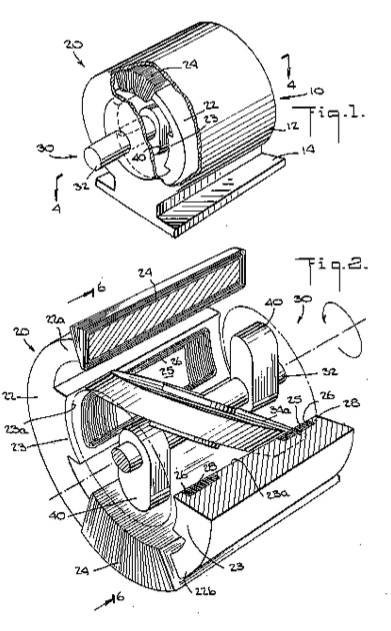
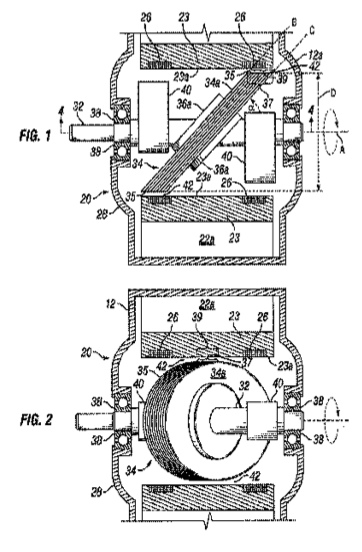
The Dynaflux machine uses an oblique/elliptical rotor armature so that magnetic flux moves parallel to the rotation axis rather than perpendicular. This geometry redirects the Lenz reaction into axial thrust instead of opposing torque, thereby reducing back-EMF and enabling much higher conversion efficiencies.
Detailed Description
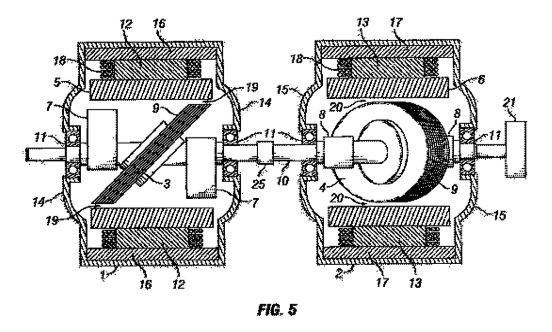
Patented in 1988 (US 4,780,632), the device features a rotor whose windings are mounted obliquely with respect to the axis of rotation. As the rotor turns, the magnetic flux reciprocates along the axis, producing two AC cycles per rotation. The design maintains a constant air gap and may incorporate multi-pole stators, toroidal windings, and back-EMF reduction techniques. Variants include multi-pole switched reluctance DC motors and toroidal motors with constant torque characteristics.
Principles
- Electromagnetic induction
- Lenz's law
- Axial flux motion
- Back-EMF reduction
- Constant air-gap design
Scientific Domains
Materials
- Copper windings
- Ferromagnetic pole pieces (steel or iron)
- Aluminum or steel rotor body
Mechanisms of Action
- Oblique rotor geometry forcing flux parallel to rotation axis
- Axial thrust instead of opposing torque
- Multi-pole stator with constant air gap
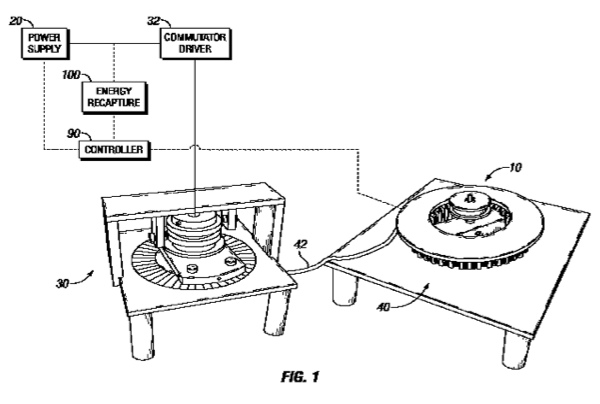
- Flux recapture via storage capacitors
Energy Sources
Applications
- Power generation
- Electric motor drives
- Renewable energy systems
- Portable generators
Claimed Performance
Ultra-high efficiency, "conversion efficiencies unheard of" and "amplifying power by nearly 5000 %".
Limitations
- No independent experimental data provided
- Scalability and manufacturing details not disclosed
- Claims of extreme efficiency lack quantitative verification
Red Flags
- Extraordinary efficiency claims without supporting data
- Marketing language ("change the world overnight", "amplifying power by 5000 %")
- Lack of peer-reviewed publications or third-party replication