Goal
Recover and recycle rare earth elements (REEs) from dilute industrial wastewater.
Problem
Scarcity and high cost of REEs combined with the difficulty of extracting them from low-concentration wastewater streams.
Concept Summary
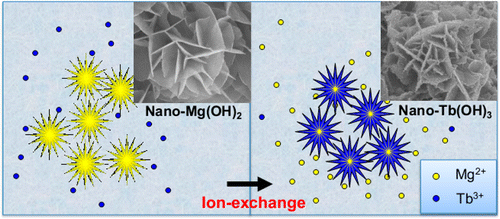
Self-supported, flower-shaped nano-magnesium hydroxide (Mg(OH)_2) particles act as an adsorbent that captures REEs from water via surface adsorption and ion-exchange mechanisms, allowing subsequent recovery of the metals and regeneration of the hydroxide.
Principles
- Adsorption
- Ion-exchange
- Surface complexation
Scientific Domains
Materials
- Magnesium hydroxide (Mg(OH)_2)
- Nano-Mg(OH)_2 (flower-like morphology)
Mechanisms of Action
- Surface adsorption of REE ions onto nano-Mg(OH)_2
- Ion-exchange between REE cations and Mg^2^+ in the hydroxide lattice
- pH-dependent precipitation of REE hydroxide nanoparticles on the adsorbent surface
Applications
- Recovery of REEs from industrial effluents
- Water treatment for metal removal
- Resource recycling in electronics manufacturing
Claimed Performance
Initial lab tests captured >85 % of REEs; later experiments reported >99 % uptake and successful immobilisation in a pilot-scale flow system.
Experimental Evidence
The authors demonstrated >85 % REE capture in an initial mimicked real-world experiment and >99 % uptake in laboratory tests; a pilot-scale experiment showed effective immobilisation at high flow rates.
Replication Status
Pilot-scale experiment reported by the authors; no independent third-party replication mentioned.
Limitations
- Performance depends on REE concentration and solution pH
- Regeneration of the adsorbent requires CO_2 treatment and calcination
- Scale-up cost and handling of solid waste not fully addressed