Goal
Provide a low-cost, environmentally-friendly energy-storage solution that surpasses the performance of rechargeable batteries and supercapacitors.
Problem
High cost, scaling difficulty, and environmental concerns of liquid-electrolyte batteries and supercapacitors; limited capacitance of conventional capacitors.
Concept Summary
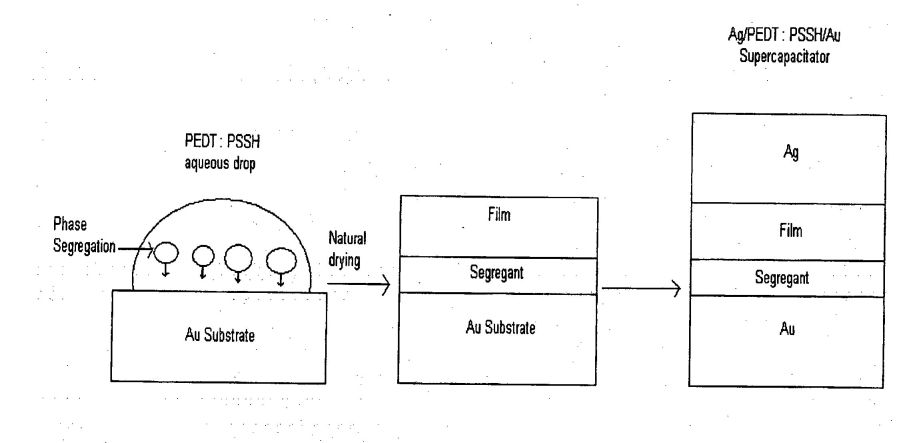
A solid-state, polystyrene-based polymer membrane (including sulfonated polymer PSSH) is sandwiched between two metal plates, acting as a highly polarizable ion-conducting capacitor with capacitance ~0.2 F/cm^2, low cost per farad, and good cycle life.
Detailed Description
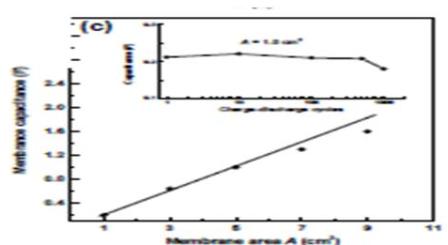
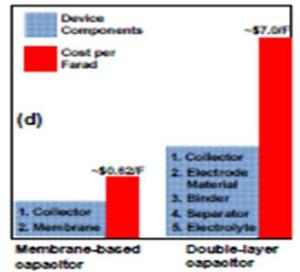
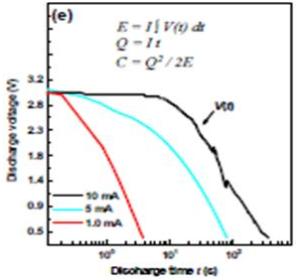
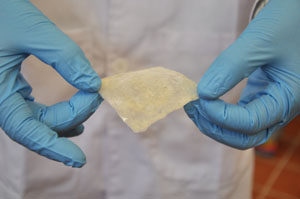
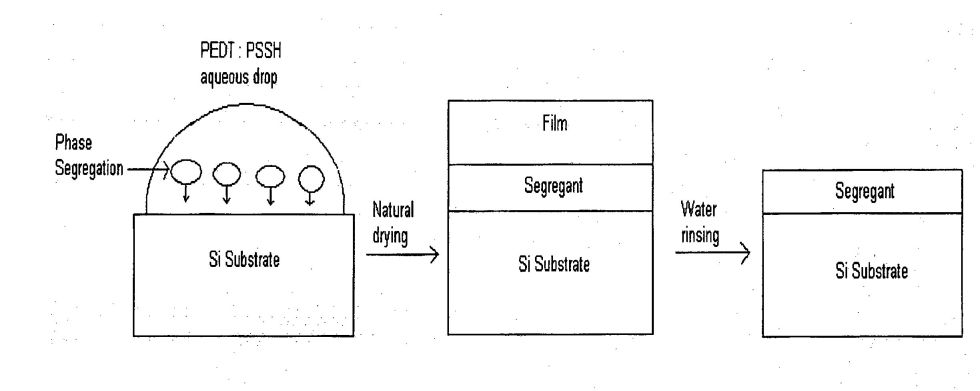
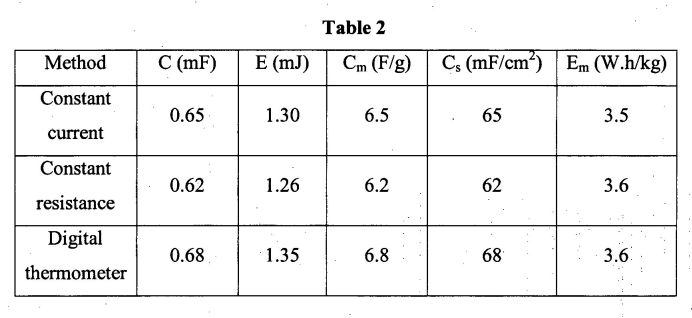
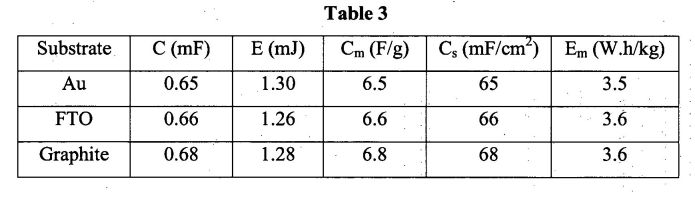
The researchers deposited a soft, foldable polystyrene-based polymer membrane that, when placed between charged metal plates, stores electrical energy through ion-conducting channels and high polarizability. The membrane exhibits a capacitance of about 0.2 F per square centimetre (far above the typical 1 uF/cm^2 of standard capacitors), an open-circuit voltage of ~3.0 V, and negligible capacity fading after 1000 charge-discharge cycles. The cost to store each farad is reduced from ~US$7 (liquid electrolytes) to US$0.62. Prototype devices demonstrated linear scaling of capacitance with membrane area, high polarization currents (~250 mA/cm^2 at 10 V), and durability at room temperature.
Principles
- Ion conduction through sulfonated polymer
- Electrostatic polarization
- Capacitive energy storage
- Solid-state electrolyte
Scientific Domains
Materials
- Polystyrene-based polymer
- Poly(styrene sulfonic acid) (PSSH)
- PEDT:PSSH composite film
- Nanomaterial (proprietary nanomaterial)
Mechanisms of Action
- Ionic conductivity in polymer network
- Polarizable membrane storing charge
- Charge separation between metal plates
Applications
- Hybrid vehicle instant power storage
- Solar panel energy management
- Wind turbine power smoothing
- Grid-scale energy storage
Claimed Performance
Capacitance ~0.2 F/cm^2, open voltage 3.0 V, cost $0.62 per farad, energy density 10-20 Wh/US$, $2.5 Wh/US$ for Li-ion, negligible capacity fading after 1000 cycles.
Experimental Evidence
Prototype devices demonstrated 0.2 F/cm^2 capacitance, linear scaling with area, polarization current ~250 mA/cm^2 at 10 V, cost per farad $0.62 vs $7 for conventional devices, and durability over 1000 cycles at room temperature.
Replication Status
Patent filed; no independent replication reported in the article.
Limitations
- Scalability and commercial production not yet demonstrated
- Long-term durability beyond 1000 cycles unverified
- Reliance on polymer stability under varied environmental conditions
Red Flags
- Patent pending, limited independent verification
- Performance claims based on prototype data only