Goal
To nullify or reverse the normal gravitational attraction between masses using electrical currents.
Problem
Inability to control or counteract gravity for scientific and practical purposes.
Concept Summary
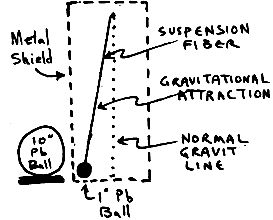
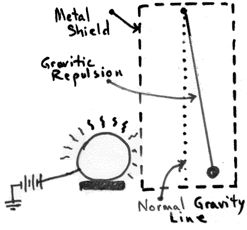
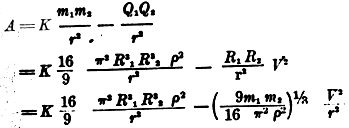
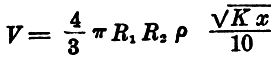
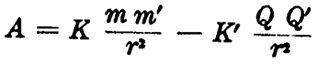
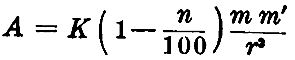
A torsion-balance setup similar to the Cavendish experiment is equipped with large lead spheres that can be charged with high-tension DC or AC currents. When electricity is applied, the normal attractive force between the large and small lead spheres is reduced, nullified, or even reversed into repulsion, allegedly due to an inter-atomic electrical reaction rather than ordinary electrostatic effects.
Detailed Description
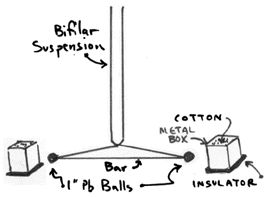
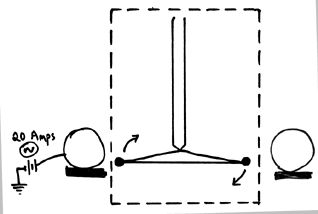
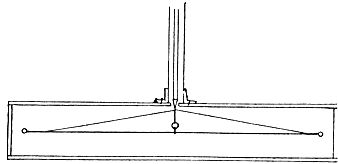
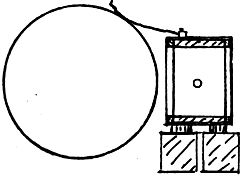
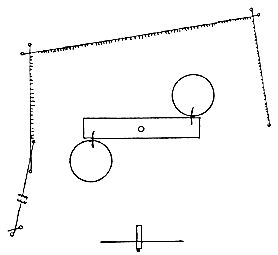
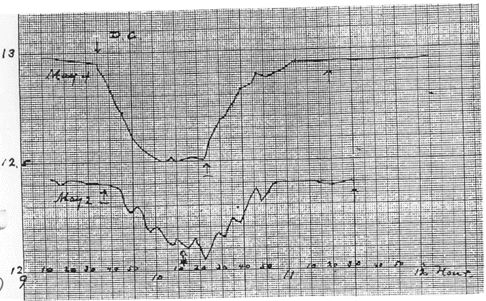
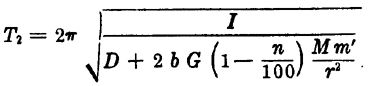
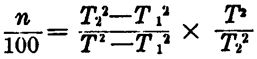
The apparatus consists of two large solid lead spheres (~=10 inches diameter) resting on hard-rubber insulators, and two small lead balls (~=1 inch diameter) suspended from silk threads on either side of the large spheres. The small balls are enclosed in a wooden box lined with tinned iron, cardboard, and a metal shield to prevent stray electrostatic influences. A high-tension current from a static machine is applied to the large spheres; both positive and negative terminals produce the same effect. With DC (~=20 A) no measurable change is observed, but with AC (~=20 A) the gravitational attraction is quickly reduced to zero and, over 15-20 minutes, the small balls move opposite to their original direction, indicating a repulsive force about 50 % of the original attraction. Control experiments using hollow metal boxes filled with cotton (no mass) showed no effect, supporting the claim that the observed repulsion is not due to simple electrostatic forces.
Principles
- Electrical charging of masses
- Torsion balance measurement
- High-tension current application
- Alternating current induced force alteration
Scientific Domains
Materials
- Lead
- Silk thread
- Hard rubber
- Wood
- Tinned iron sheet
- Cardboard
- Metal shield
- Copper wire
- Glass
- Cotton batting
Mechanisms of Action
- Inter-atomic electrical reaction affecting gravitational coupling
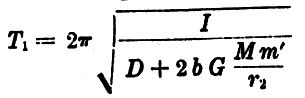
- Modification of effective gravitational constant by applied potential
- Alternating current causing time-varying electromagnetic fields that reduce attraction
Energy Sources
Applications
- Gravity control research
- Propulsion concepts
- Anti-gravity devices
Claimed Performance
Repulsive force up to twice the normal gravitational attraction; AC 20 A produced a repulsion equal to about 50 % of the original attraction within 15-20 minutes.
Experimental Evidence
Repeated laboratory runs in summer 1917 showed consistent conversion of attraction to repulsion when AC current was applied; control tests with mass-less metal boxes showed no effect, suggesting the phenomenon is not due to simple electrostatic forces.
Replication Status
Repeated by the author; no independent third-party replication reported.
Limitations
- Qualitative observations only; no precise quantitative measurements
- No independent replication or peer-reviewed publication
- Potential for unnoticed electrostatic or magnetic artifacts
- Requires high currents and large lead masses
Red Flags
- Extraordinary claim of reversing gravity without a solid theoretical basis
- Lack of peer-reviewed data or independent verification
- Potential for over-unity or free-energy implications