Goal
Provide a non-lethal, highly directional acoustic device that can incapacitate or deter targets without affecting bystanders.
Problem
Conventional acoustic weapons disperse sound in all directions, endangering operators and bystanders; a need exists for a focused sound source that can be turned on/off instantly.
Concept Summary
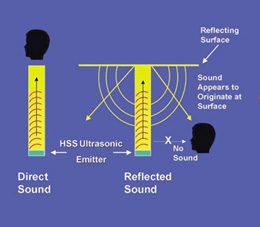
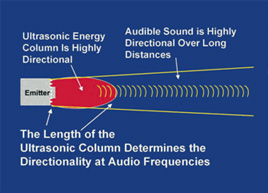
The system uses a high-frequency ultrasonic carrier wave that is electronically modulated with audible information. In air the ultrasonic beam undergoes nonlinear interaction, demodulating the audible signal only within the narrow beam, producing a "sonic bullet" that can reach up to 145 dB and cause temporary pain or disorientation.
Detailed Description
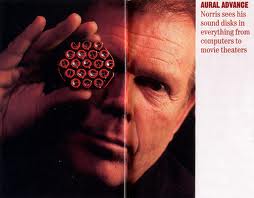
Elwood "Woody" Norris' HyperSound System (HSS) replaces a traditional speaker diaphragm with an array of ultrasonic transducers that emit a tightly focused beam of ultrasound (>20 kHz). The audible audio is encoded onto the ultrasonic carrier via amplitude modulation. As the carrier propagates through air, its high intensity causes nonlinear acoustic effects that demodulate the audible component, allowing listeners inside the beam to hear the sound while those outside hear nothing. The device can be mounted on a camouflaged cylinder, handheld, or vehicle-mounted, and can be switched off instantly, leaving no lingering residue. Demonstrations showed subjects leaving the beam path at 110 dB and experiencing severe discomfort at higher levels. The U.S. Army has ordered a prototype for crowd-control and anti-terrorist applications.
Principles
- Parametric array (nonlinear acoustic demodulation)
- Ultrasonic carrier modulation
- Directional sound beam formation
- High-intensity ultrasound interaction with air
Scientific Domains
Materials
- Piezoelectric ceramic transducers
- Metal housing
- Electrical wiring
Mechanisms of Action
- Ultrasonic carrier creates a narrow, high-intensity beam
- Nonlinear interaction of ultrasound with air demodulates the audible signal
- Audible sound within the beam causes pain, disorientation, or temporary vestibular effects
Energy Sources
Applications
- Non-lethal crowd control
- Targeted advertising
- Personal audio zones
- Bird deterrence
- Emergency exit signage
Claimed Performance
Beam intensity up to 145 dB (~=50x pain threshold); can stop a person in its path; non-lethal and instantly switchable.
Experimental Evidence
A demonstration in the company parking lot forced subjects to leave the beam at 110 dB; the U.S. Army has ordered a prototype for field testing.
Replication Status
Prototype ordered by the U.S. Army; no independent third-party replication reported.
Limitations
- Beam can be blocked by obstacles
- High power consumption
- Potential hearing damage if misused
- Limited effective range outdoors due to atmospheric attenuation
Red Flags
- Potential for misuse as a weapon
- Claims of immediate incapacitation lack quantitative data