Goal
Provide a portable, self-powered electric source for devices such as flashing lamps without reliance on batteries or external wiring.
Problem
Limited lifetime and replacement cost of conventional batteries for remote or portable flashing lights and similar low-power devices.
Concept Summary
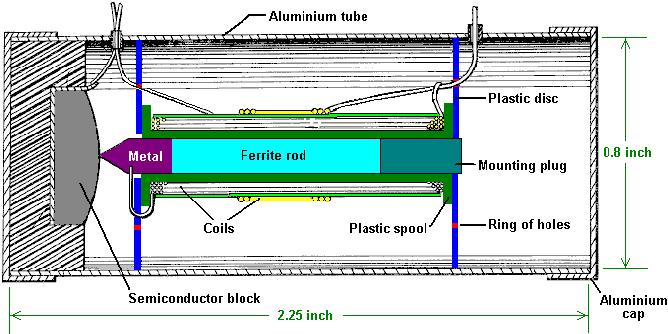
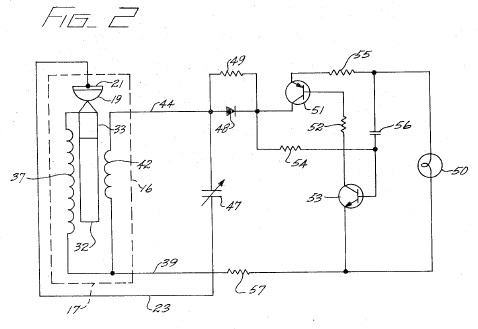
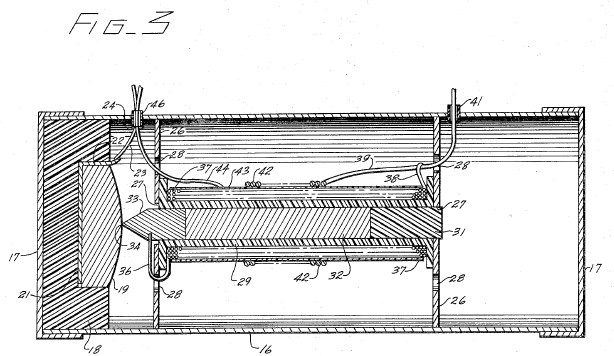
A semiconductor tablet composed of selenium doped with tellurium, germanium, neodymium, gallium and rubidium is placed inside a metal cylinder together with a ferrite core, primary/secondary helical coils, and a metal probe. An initial oscillating signal (5.8-18 MHz) excites a resonant cavity; the resulting oscillations are inductively coupled to the secondary coil, rectified, and used to power a load. The device claims to become self-powered after the brief excitation, possibly harvesting ambient radio-frequency energy.
Detailed Description
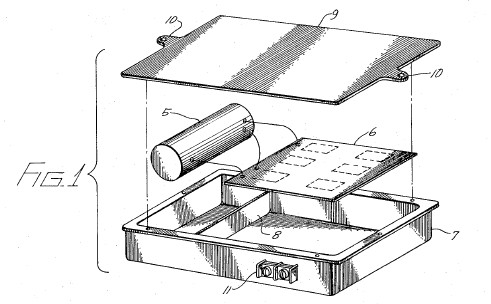
The invention consists of a cylindrical metal envelope (typically aluminum) housing a domed semiconductor tablet (~=3.8 g) made from a specific alloy of selenium, tellurium, germanium, neodymium, gallium and rubidium. A metal probe contacts the dome and a ferrite rod. Primary helical coil (800-1000 turns) and secondary coil (8-10 turns) are wound on a plastic spool around the ferrite core. A variable capacitor forms a tank circuit with the inductance of the coils, creating a resonant cavity. When a brief external oscillating signal (5.8-18 MHz) is applied, the cavity resonates, producing voltage that is half-wave rectified by a diode and supplied to a relaxation oscillator and an incandescent lamp. Demonstrated output is several volts, 170-250 mW, sufficient for a lamp requiring ~250 mA. The device is claimed to operate without moving parts or electrochemical reactions.
Principles
- Resonant amplification
- Electromagnetic induction
- Semiconductor doping effects
- Rectification
Scientific Domains
Materials
- Selenium
- Tellurium
- Germanium
- Neodymium
- Gallium
- Rubidium
- Aluminum
- Ferrite (magnetic core)
- Copper (coil wire)
- Plastic (spool, cup)
Mechanisms of Action
- Resonant cavity oscillation
- Inductive coupling between primary and secondary coils
- Semiconductor charge storage and release
- Half-wave rectification
Energy Sources
Applications
- Portable flashing lights
- Remote low-power sensors
- Battery-free power supplies
Claimed Performance
Provides flashing power for an incandescent lamp up to 250 mA; several volts output; demonstrated power 170-250 mW.
Experimental Evidence
The patent description states that the device has been shown to power an incandescent lamp requiring about 250 mA, delivering several volts and 170-250 mW of power after a brief excitation.
Limitations
- Low power output (~=250 mW)
- Requires initial external oscillation
- Unclear long-term stability
- Dependence on ambient RF (if any)
- No independent replication
Red Flags
- Claims of self-power without apparent energy input
- Potential free-energy implication
- Lack of peer-reviewed validation