Goal
Achieve soot-free, low-emission combustion for cleaner energy use and oil-spill remediation
Problem
High pollutant emissions and inefficient burning in conventional pool fires and oil-spill clean-up fires
Concept Summary
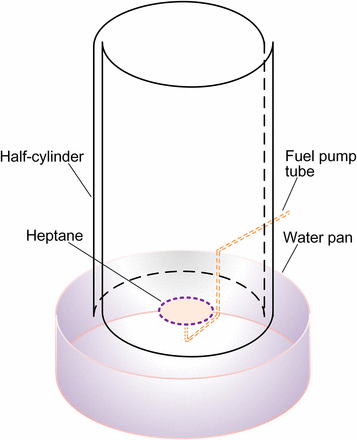
A stable, laminar blue flame (the "blue whirl") is produced by placing two quartz half-cylinders over a fuel-on-water pool fire. The geometry creates strong tangential air entrainment and intense vortex mixing, while the water-surface boundary supplies evaporating fuel. The resulting vortex-driven flame burns with nearly complete oxidation, eliminating soot and reducing emissions.
Detailed Description
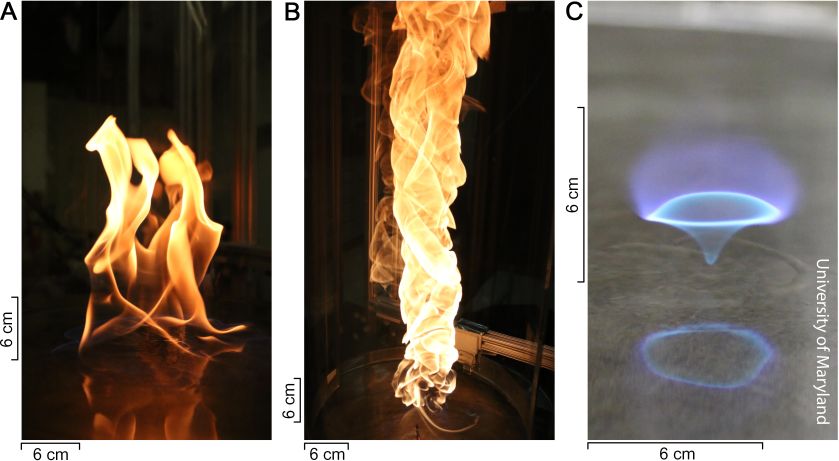
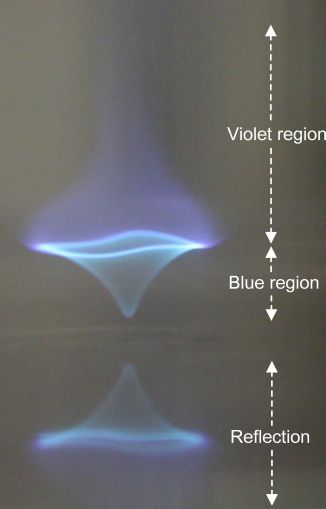
In laboratory experiments a pool of n-heptane is spread on the surface of quiescent water in a stainless-steel pan. Two quartz half-cylinders are positioned above the pan, leaving vertical slits that channel ambient air tangentially into the flame region, forming a vortex. A small copper tube injects fuel at 0.8-1.2 mL min^-^1, sustaining the blue whirl for up to ~8 minutes. The flame consists of a bright blue base (~=0.42 cm high) and a faint violet conical region (2-6 cm), total height 4-8 cm, rotating at ~=6.3 rad s^-^1. The vortex promotes rapid mixing of fuel vapor and oxygen, leading to complete combustion and a laminar, turbulence-free flame.
Principles
- Vortex-induced rapid mixing
- Laminar flame stabilization
- Water-surface evaporation of hydrocarbon fuel
Scientific Domains
Materials
- Quartz
- Stainless steel
- Copper
- n-heptane
Mechanisms of Action
- Intense swirling creates high shear and fast mixing of fuel and oxidizer
- Water-surface boundary provides a steady evaporating fuel source
- Quartz half-cylinders shape the airflow to sustain a stable vortex
Energy Sources
Applications
- Oil-spill cleanup by in-situ burning
- Low-emission combustion for industrial burners
Claimed Performance
Nearly soot-free combustion; stable blue whirl sustained for up to 8 minutes at a fuel flow of 0.8-1.2 mL min^-^1.
Experimental Evidence
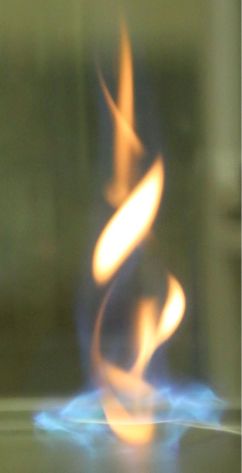
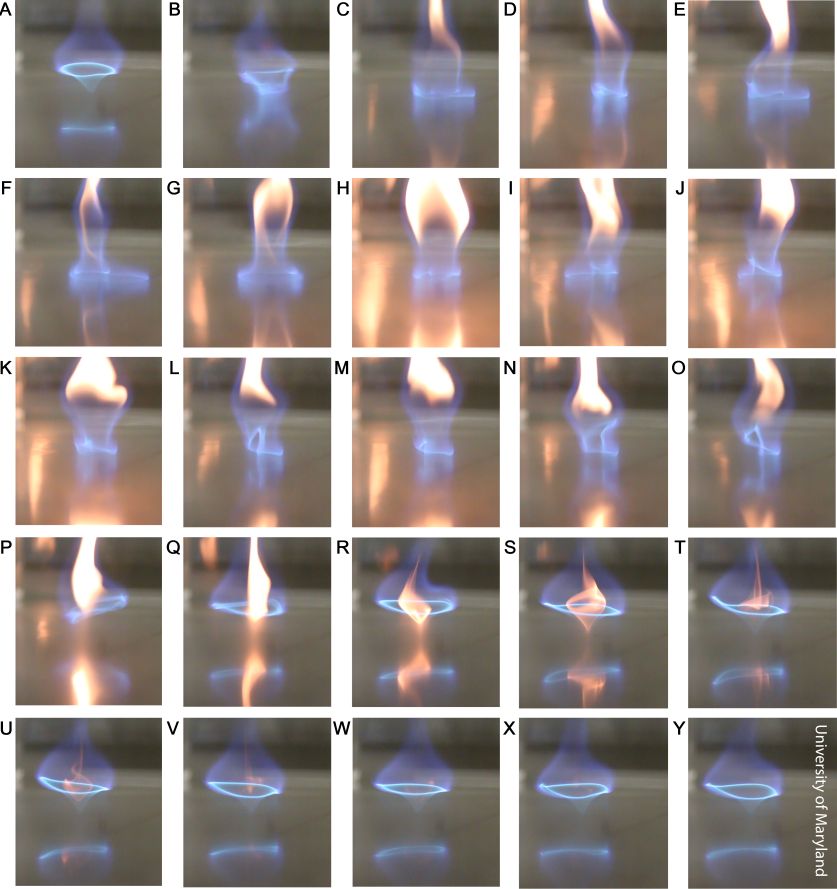
Laboratory tests in a controlled chamber showed the transition from a pool fire to a fire whirl and finally to a blue whirl, which remained stable for just under 8 minutes before fuel was cut off.
Replication Status
Only reported in the original University of Maryland study; no independent replication mentioned.
Limitations
- Demonstrated only in small laboratory scale
- Requires precise geometry and water surface
- Sustained operation limited by fuel supply and heat removal