Goal
Generate electrical power by absorbing electromagnetic waves and atmospheric electricity using an ionized-air conductor.
Problem
Inefficient utilization of atmospheric electricity and wireless transmission of power; need for a method to capture dispersed electromagnetic energy.
Concept Summary
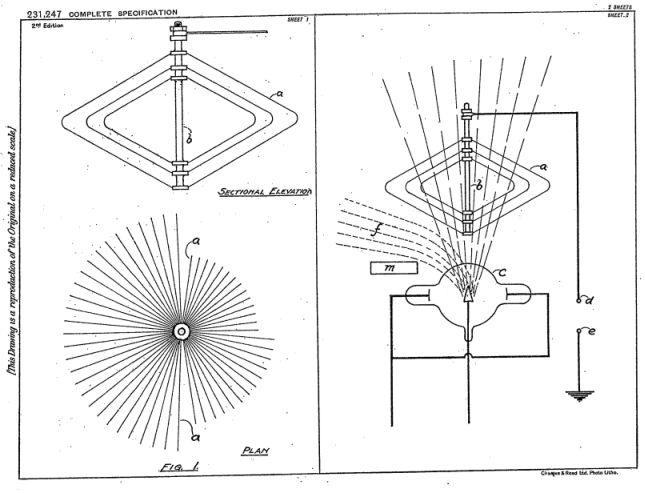
A network of fine copper wires arranged in a flat rhombus is exposed to a strong beam of Roentgen (X-ray) rays from a Crookes/Thomson tube. The rays ionize the surrounding air, making it conductive and allowing it to act as an "invisible conductor" that absorbs ambient electromagnetic waves and atmospheric electric fields. The ionized air imparts charge to the copper wires, creating a potential difference that drives an electric current usable for power generation.
Principles
- Electromagnetic wave absorption
- Air ionization by X-ray (Roentgen) radiation
- Electrostatic induction
- Resonance of electrical oscillations
- Potential-difference driven current flow
- Conduction through ionized gas
Scientific Domains
Materials
- Copper wire
- Platinum cone
- Aluminum conductors
- Gold leaf (electroscope)
- Ebonite rod
- Glass
Mechanisms of Action
- Roentgen rays ionize air, increasing its conductivity
- Ionized air acts as a conductive path that absorbs ambient electromagnetic energy
- Charged air transfers electrons to the copper wire network, creating a voltage difference
- Current flows through the wires due to the maintained potential difference
Energy Sources
Applications
- Remote power generation
- Wireless energy transmission
- Atmospheric energy harvesting
Claimed Performance
The apparatus is claimed to continuously generate electric current by continuously absorbing ambient electromagnetic and atmospheric electric energy; no quantitative power figures are provided.
Experimental Evidence
The inventor describes a gold-leaf electroscope test where exposure to Roentgen rays causes the leaves to collapse, indicating air ionization and loss of insulating properties. He also reports that ionized air conducts electricity to the copper wires, producing a measurable current.
Limitations
- Requires a high-intensity X-ray source, which is hazardous and energy-intensive
- No quantitative data on power output or efficiency
- Reliance on ionized air may be limited by atmospheric conditions
- Concept depends on outdated ether theory
Red Flags
- References to "ether" and "etheric" conduction, which are not accepted in modern physics
- Claims of continuous power generation without quantitative evidence
- Potential health hazards from prolonged X-ray exposure