Goal
Increase fuel efficiency and reduce emissions by recycling exhaust gases and pretreating fuel before it enters the combustion chamber.
Problem
Low efficiency of two-stroke and four-stroke engines and the presence of unburnt fuel, CO_2, CO, and other pollutants in exhaust.
Concept Summary
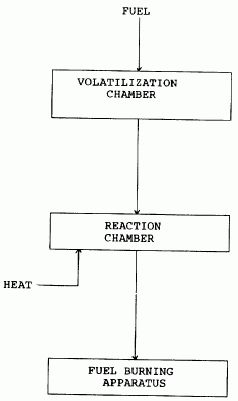
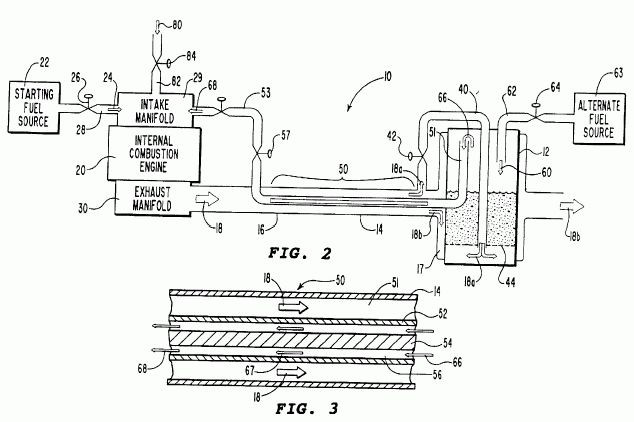
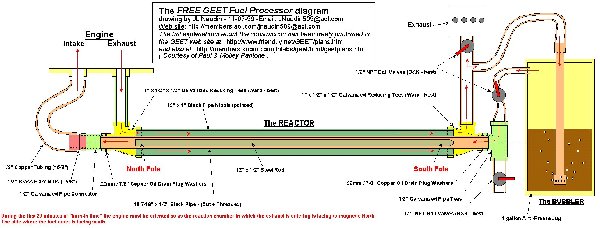
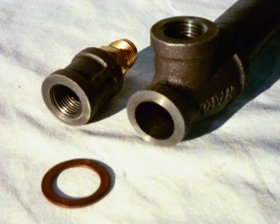
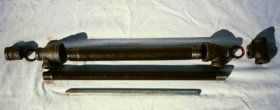
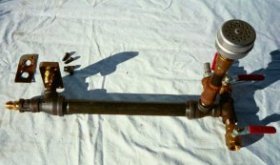
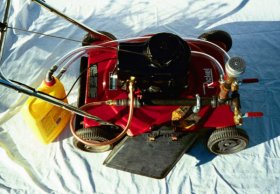
The GEET system routes engine exhaust through a concentric pipe arrangement where the hot exhaust heats the outer pipe, catalyzes reduction reactions, and bubbles through a water-fuel mixture. The resulting gas mixture is enriched with hydrogen, methane, carbon monoxide, and magnetically polarized "magnegas". The treated exhaust is then fed back to the engine intake, improving combustion efficiency.
Principles
- Heat exchange between exhaust and pipe walls
- Ranque-Hilsch vortex effect for temperature separation
- Catalytic reduction of CO_2 and H_2 to CH_4 and H_2O
- Magnetic polarization of diatomic molecules (magnetization of steel surfaces)
- Pressure-driven dissolution of CO_2 in water
- Metal-mediated water reduction to hydrogen (Zn, Mg)
Scientific Domains
Materials
- Steel pipe
- Iron bar
- Nickel catalyst
- Zinc powder
- Magnesium powder
- Glass wool insulation
- Water
- Gasoline or other alternate fuel
- Algae biomass (optional)
- Anaerobic bacteria (optional)
Mechanisms of Action
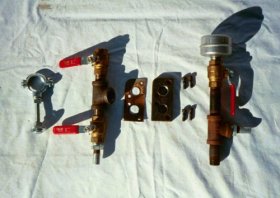
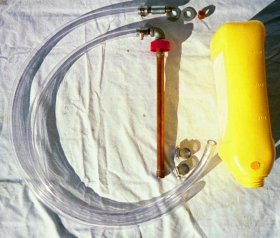
- Exhaust heat volatilizes alternate fuel in a bubbler
- Catalytic surfaces (nickel) convert CO_2 + H_2 -> CO + H_2O and CO_2 + 4H_2 -> CH_4 + 2H_2O
- Magnetized steel bar creates high-Tesla fields that polarize gases into magnecules
- Ranque-Hilsch effect concentrates hot gases on outer pipe and cool gases on inner bar
- High pressure in the bubbler dissolves CO_2, which can be reduced by Zn/Mg to release H_2
Energy Sources
Applications
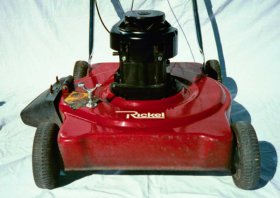
- Internal combustion engines
- Small generators
- Furnaces
- Boilers
- Turbines
Claimed Performance
Significant improvement in engine efficiency, especially for two-stroke engines, due to recycling of unburnt fuel and generation of high-energy magnegas; the inventor claims the system can run on ~80 % water and 20 % fuel.
Experimental Evidence
The patent description and accompanying article cite observed efficiency gains and reduced CO_2 in the exhaust, but no quantitative data, peer-reviewed studies, or independent replication are provided.
Limitations
- Requires precise temperature and pressure control
- Metal oxidation and catalyst degradation over time
- CO_2 retained in water reduces net gain
- Lack of independent, quantitative testing
Red Flags
- Claims of 80 % water fuel ratio are not substantiated
- Potential for overstating efficiency (possible fraud)
- No peer-reviewed or third-party validation