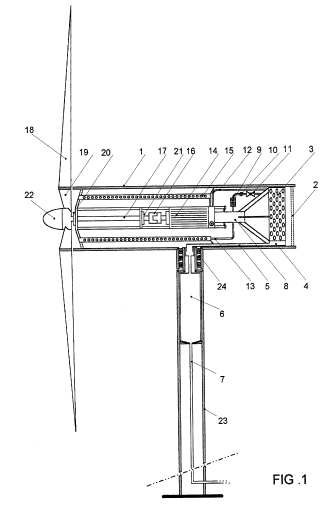
Goal
Generate liquid water from ambient air using wind energy
Problem
Lack of accessible fresh water for populations in arid or remote regions
Concept Summary
A wind-driven motor powers a refrigeration circuit that cools an evaporator. Air forced over the evaporator condenses water vapor, which is collected and stored. When wind stops, a secondary energy source can continue the cooling cycle.
Detailed Description
The system consists of a mast-mounted turbine that drives a compressor and a cooling loop. The loop circulates a refrigerant through an evaporator exposed to ambient air. As the refrigerant absorbs heat, the evaporator surface temperature drops below the dew point, causing water vapor to condense. Condensed droplets run into a storage tank within the mast. A backup power source can operate the compressor when wind power is unavailable.
Principles
- Thermodynamic refrigeration cycle
- Condensation of water vapor
- Wind turbine energy conversion
- Suction effect of turbine for air intake
Scientific Domains
Materials
- Steel (mast and turbine housing)
- Copper tubing (refrigerant circuit)
- Aluminium (evaporator fins)
- Polymer seals
- Refrigerant fluid (e.g., R-134a or similar)
Mechanisms of Action
- Wind-driven rotor blades spin a compressor
- Compressor pressurizes refrigerant in a closed loop
- Refrigerant evaporates, absorbing heat from ambient air
- Air passing over the cold evaporator surface reaches dew point
- Water droplets coalesce and are channeled to a storage tank
Energy Sources
Applications
- Remote community water supply
- Disaster relief water provision
- Off-grid potable water generation
Claimed Performance
Produces water from thin air using wind energy
Limitations
- Dependence on sufficient wind speed
- Limited water output in low-humidity environments
- Requires backup power for continuous operation
- Potential scaling challenges for large-volume demand