Goal
Eliminate nitrogen oxides (NOx) from exhaust gases of vehicles and industrial power plants.
Problem
Air-pollution caused by NOx emissions, which contribute to smog, ozone formation, and acid rain.
Concept Summary
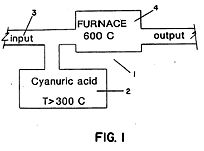
Cyanuric acid is heated to sublimate, producing isocyanic acid (HNCO). The HNCO gas is mixed with the NO-containing exhaust stream, where it rapidly reacts with NOx to form harmless nitrogen, carbon dioxide and water vapor. The process uses the exhaust heat to drive sublimation and decomposition, requiring no catalysts or toxic additives.
Detailed Description
The invention consists of a storage compartment for solid cyanuric acid, a heating element that brings the acid to ~625 deg F (the temperature at which it sublimates), and a mixing zone where the generated HNCO vapor contacts the exhaust gas. The hot exhaust further decomposes any residual HNCO, completing the reduction of NOx. Laboratory tests with a small diesel engine showed near-complete removal of NOx in a few milliseconds. The system is inexpensive, portable, non-toxic, and can be scaled from vehicle exhausts to large stationary smokestacks.
Principles
- Sublimation of a solid to generate a reactive gas
- Gas-phase neutralization of NOx by isocyanic acid
- Heat-induced decomposition of HNCO
- Rapid kinetic reaction (milliseconds)
Scientific Domains
Materials
- Cyanuric acid (solid)
- Isocyanic acid (HNCO) - generated in situ
Mechanisms of Action
- HNCO reacts with NO -> N_2 + CO_2 + H_2O
- Thermal decomposition of HNCO in hot exhaust stream
Energy Sources
Applications
- Vehicle exhaust NOx control (diesel trucks, buses)
- Stationary power-plant smokestack emission reduction
- Industrial furnace and kiln exhaust treatment
Claimed Performance
Laboratory diesel engine test removed essentially all NOx; one pound of cyanuric acid can treat exhaust for roughly 500 miles of driving.
Experimental Evidence
In a laboratory experiment a small diesel engine, introduction of sublimated cyanuric acid (HNCO) cleaned essentially all oxides of nitrogen from the exhaust within a few milliseconds.
Limitations
- Requires sufficient exhaust heat to sublimate cyanuric acid
- Handling of toxic HNCO gas must be managed
- Effectiveness at very low NO concentrations not yet demonstrated
- Scalability and long-term durability not proven
Red Flags
- HNCO is a toxic gas; accidental release could pose health hazards
- Laboratory results may not translate directly to large-scale operation