Goal
Provide a low-friction, low-emission power source that replaces petrol or battery engines using compressed air.
Problem
High emissions and inefficiencies of internal-combustion and battery-powered vehicles; need for a quiet, lightweight engine for garden and industrial use.
Concept Summary
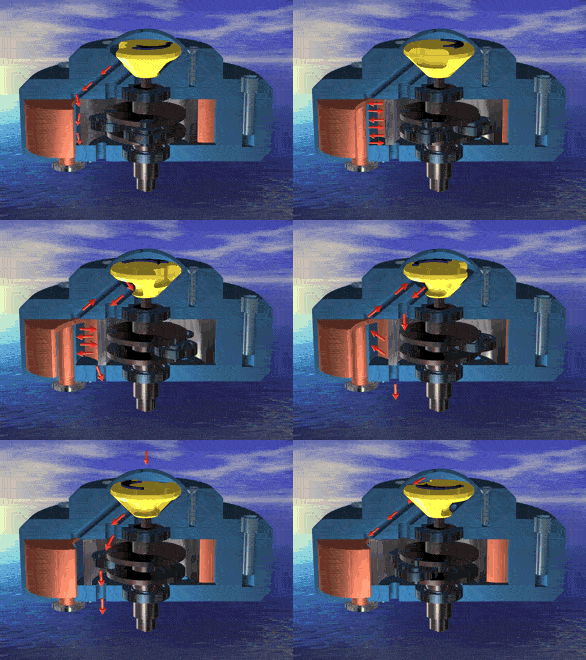
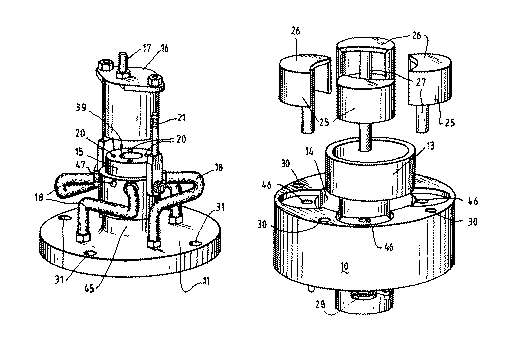
A rotary piston engine in which a cylindrical shaft driver rolls inside a stator, creating six expansion chambers separated by pivoting dividers. Compressed air enters the chambers, expands, and drives the shaft via rolling elements cushioned by a thin air film. Timing is controlled by a slotted timer on the output shaft. The design claims very low friction and high torque at low pressure.
Detailed Description
The engine consists of a cylindrical stator and a cylindrical rotary piston (shaft driver) that rolls eccentrically inside it. Six expansion chambers are formed by pivoting dividers that follow the rotor's motion. Pressurized air is admitted through a timed inlet; the expanding air pushes the rotor, which transfers torque to the output shaft via two rolling elements on bearings. A thin air film provides lubrication, eliminating metal-to-metal contact. The inlet timing can be varied to trade torque for efficiency. A slotted timer mounted on the output shaft governs the inlet and exhaust phases. Prototypes have been built since 1999, with claimed performance of 40-60 km/h vehicle speed, 16 km range on a 100 L cylinder, and operation at as low as 1 psi to overcome friction.
Principles
- Compressed-air expansion
- Rotary piston motion
- Air-film lubrication
- Timed inlet/exhaust control
Scientific Domains
Materials
- Metal alloys (steel/aluminum) for stator and rotor
- Bearings
- Rubber/Polymer seals
Mechanisms of Action
- Air pressure forces the cylindrical rotor outward, creating eccentric motion
- Expansion of air in six chambers produces torque
- Thin air film reduces friction between rotor and stator
- Slotted timer regulates air inlet and exhaust timing
Energy Sources
Applications
- Garden maintenance vehicle
- Park maintenance vehicle
- Industrial pumps
- Go-kart
- Boat
Claimed Performance
Speeds of 40-60 km/h; 1 hour runtime on a garden buggy; 16 km range on a 100 L cylinder; only 1 psi needed to overcome friction; near-100 % efficiency claim compared to other air motors.
Experimental Evidence
Garden buggy tests showing 40-50 km/h for one hour; vehicle tests reaching 50-60 km/h uphill; road-going tests in a passenger car, go-kart, and boat; commercial trial with CityWide garden-maintenance vehicle.
Replication Status
Multiple prototypes built and tested in several vehicle types; commercial trial underway with CityWide; no independent peer-reviewed replication reported.
Limitations
- Limited range due to cylinder size
- Heat loss during expansion reduces overall efficiency
- Requires high-pressure storage infrastructure
- Efficiency claims not independently verified
Red Flags
- Near-100 % efficiency claim lacks quantitative backing
- No peer-reviewed data or independent replication documented
- Potential overstating of performance compared to conventional engines