Goal
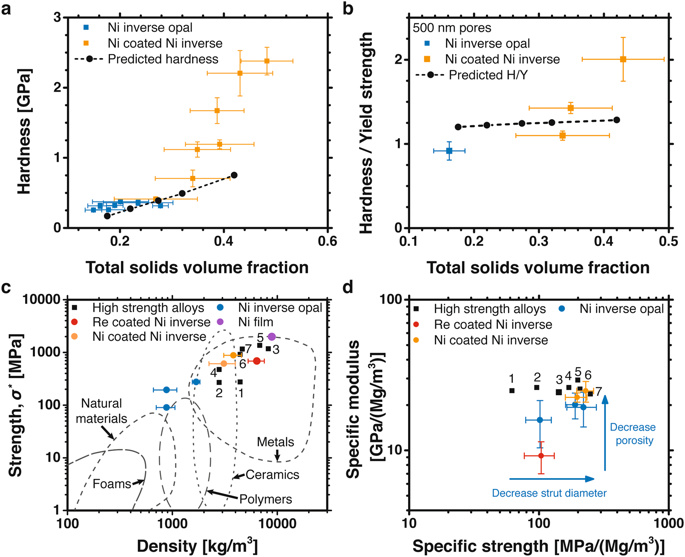
Create a structural material with the strength of titanium but the density of water, enabling lightweight high-strength components.
Problem
Conventional high-strength metals (e.g., titanium) are relatively heavy; existing lightweight materials lack sufficient mechanical strength for demanding applications.
Concept Summary
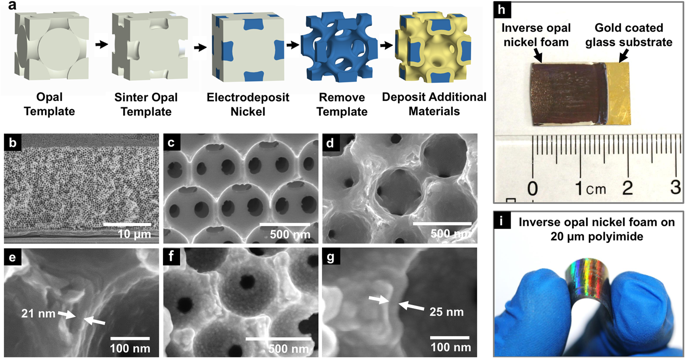
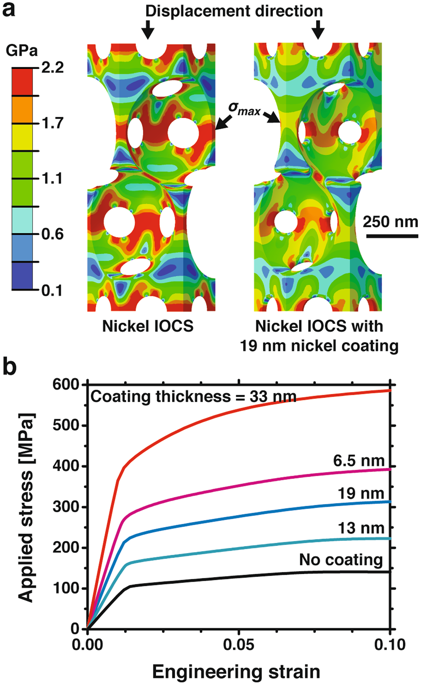
A porous nickel cellular material fabricated by self-assembly of polystyrene spheres into an ordered lattice, electroplating nickel into the interstices, and then removing the polymer to leave an inverse-opal structure with nanoscale struts. The resulting "metallic wood" combines high strength (size-dependent strengthening of nanostructured struts) with low density.
Detailed Description
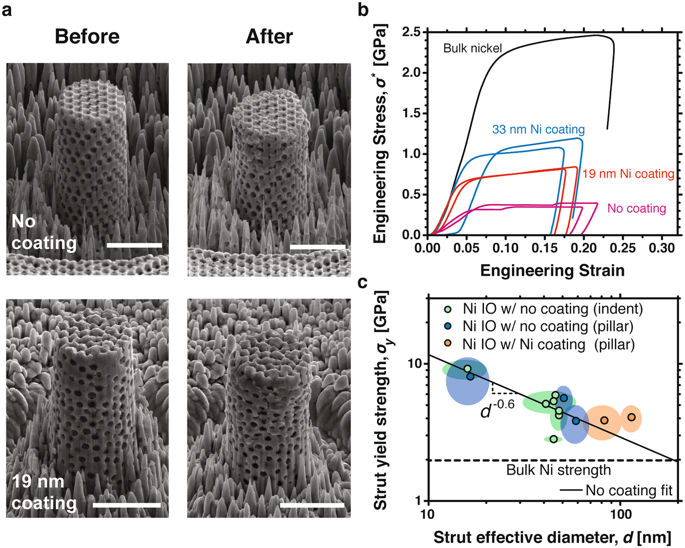
The process starts with monodisperse polystyrene beads (~=260-930 nm) that self-assemble in water into a face-centered-cubic lattice as Slow evaporation orders the beads, forming a crystalline scaffold. Nickel is electrodeposited into the voids, filling the spaces between beads. The polymer is dissolved with tetrahydrofuran, leaving an open-cell nickel network (inverse opal). Strut diameters can be as small as ~10 nm, giving yield strengths up to 8 GPa (~=4x bulk nickel). The material's density is ~1 g cm^-^3 (~= water). Variations in bead size, plating thickness, and alloying (e.g., rhenium-nickel) allow tuning of mechanical properties. Samples up to 100 mm^2 have been fabricated; larger-scale production remains a challenge.
Principles
- Size-dependent strengthening
- Inverse-opal self-assembly
- Electroplating infiltration
Scientific Domains
Materials
- Nickel (99.9 %)
- Polystyrene (PS) spheres
- Rhenium-nickel alloy (optional coating)
- Tetrahydrofuran (solvent for polymer removal)
Mechanisms of Action
- Nanometer-scale struts increase yield strength
- Porosity reduces overall density while maintaining load-bearing pathways
Applications
- Aircraft wing structures
- Prosthetic limbs
- Energy-storage scaffolds
- Lightweight structural panels
Claimed Performance
Strength comparable to titanium (yield strength up to 8 GPa), density similar to water (~1 g cm^-^3), specific strength up to 230 MPa*cm^3/kg, and ability to fabricate sheets up to 100 mm^2.
Experimental Evidence
Compression and nano-indentation tests on nanopillars show yield strength increasing from 3.8 GPa to 8.1 GPa as strut diameter decreases from 115 nm to 17 nm. Samples of metallic wood (~=1 cm^2) containing ~1 billion struts have been produced and mechanically characterized.
Replication Status
Laboratory-scale fabrication demonstrated; no commercial scaling reported.
Limitations
- Scaling the nanostructured fabrication to industrial sizes is difficult
- Requires controlled self-assembly and precise electrodeposition equipment
- Mechanical behavior of large-area components not yet fully characterized