Goal
Demonstrate that the physicochemical properties of water and aqueous solutions depend on the electric charge (potential) of the water.
Problem
Insufficient understanding of how water's electric potential influences its physical, chemical, and biological behavior.
Concept Summary
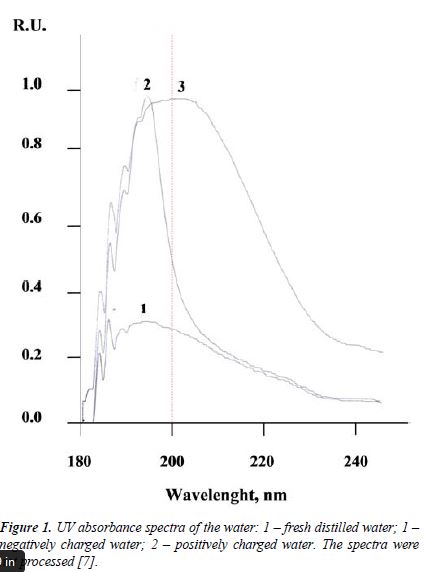
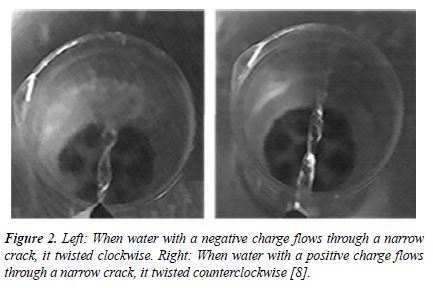
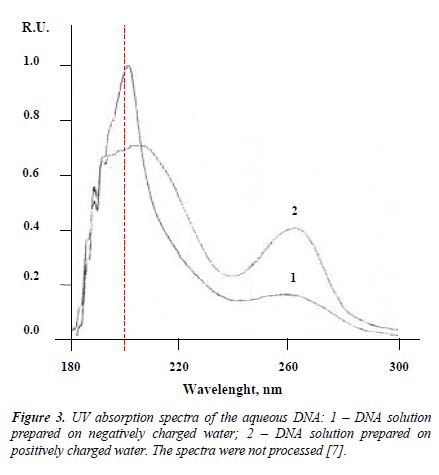
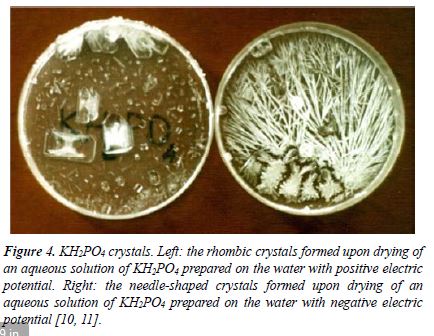
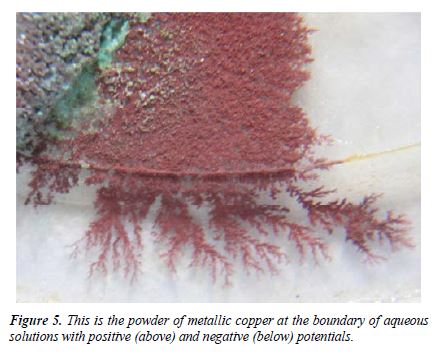
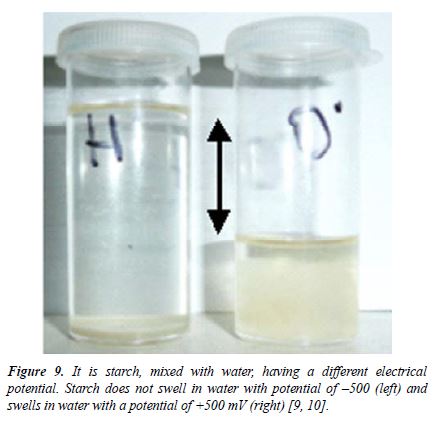
The work shows that water can be given a positive or negative electric potential by passing it through gases (O_2, H_2) or sorbents (silica gel, activated carbon). Charged water exhibits distinct properties: rotation direction in narrow gaps, different UV absorption spectra, altered surface tension, and characteristic crystal morphologies upon evaporation. These effects extend to aqueous solutions and biological polymers such as DNA.
Principles
- Electrostatic charging of water
- Surface tension modulation by electric potential
- Charge-dependent crystal nucleation
- Lorentz force interaction with geomagnetic field
- UV spectral changes linked to water charge
Scientific Domains
Materials
- Distilled water
- Gaseous oxygen
- Gaseous hydrogen
- Silica gel
- Activated carbon
- Aluminum container
Mechanisms of Action
- Passing uncharged water through gaseous O_2 or H_2 to impart positive or negative charge
- Filtering water through silica gel (hydroxyl ion sorbent) or activated carbon (hydrogen ion sorbent)
- Measuring potential as flow or filtration potential
- Observing rotation of water in narrow cracks under geomagnetic influence
- Analyzing UV absorption, crystal shape, and surface tension of charged water
Applications
- Controlled crystallization processes
- DNA and polymer hydration enhancement
- Surface tension modulation for fluid handling
- Potential aerodynamic lift augmentation via charged water vapor
Claimed Performance
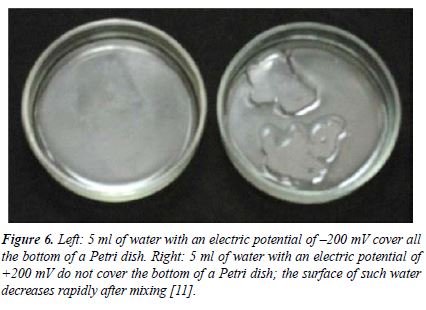
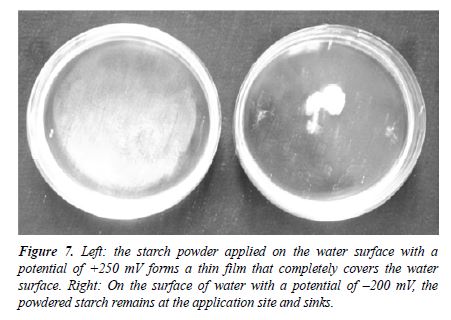
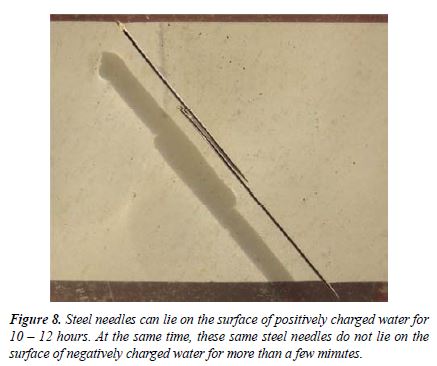
Positive potential increases surface tension, enhances DNA hydration, yields cubic crystals; negative potential decreases surface tension, yields needle-like crystals, and causes clockwise rotation in narrow gaps.
Experimental Evidence
Observed clockwise rotation of negatively charged water and counter-clockwise rotation of positively charged water in narrow cracks; UV absorption spectra differences between positively and negatively charged water; crystal morphology (cubic vs. needle) from drying saline solutions; surface tension variation measured by spreading behavior in Petri dishes.
Limitations
- Qualitative observations without rigorous quantitative data
- Dependence on geomagnetic field orientation not fully characterized
- No independent replication reported
- Mechanistic explanations remain speculative
Red Flags
- Claims of lift enhancement based on geomagnetic Lorentz force lack peer-reviewed validation
- Potential pseudoscientific interpretation of water "internal structure"
- Absence of standardized measurement protocols for water potential