Goal
Provide a lightweight, renewable, low-cost material that can store electrical energy like a supercapacitor.
Problem
Need for inexpensive, flexible, and environmentally friendly energy-storage solutions to balance intermittent renewable power generation.
Concept Summary
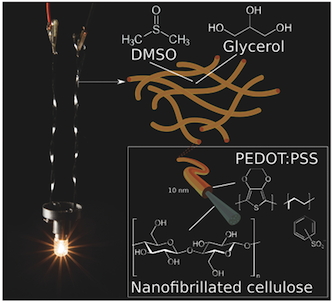
A flexible sheet made of nanocellulose fibres coated with the conductive polymer PEDOT:PSS forms a mixed ion-electron conductor. The porous fibre network holds water-based electrolyte, allowing simultaneous ion and electron transport and giving capacitor-like energy storage.
Detailed Description
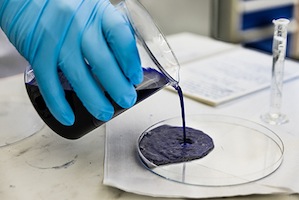
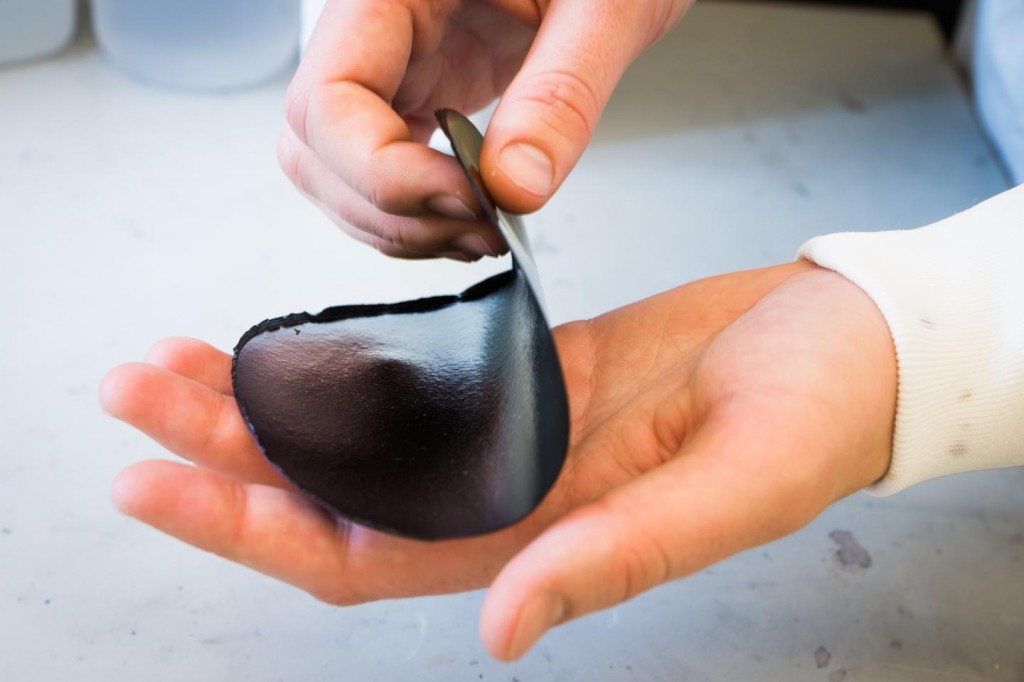
The material is produced by dispersing nanocellulose fibres (~=20 nm diameter) in water, adding an aqueous solution of PEDOT:PSS, and allowing the polymer to coat the fibres. The coated fibres tangle to create a porous matrix; the water filling the inter-fibre spaces acts as the electrolyte. The resulting "paper" can be fabricated as sheets (e.g., 15 cm diameter, a few hundred microns thick) that store up to 1 F, charge in seconds, and be recharged hundreds of times. The paper is lightweight, waterproof, and free of hazardous chemicals.
Principles
- Capacitive energy storage
- Mixed ion-electron conduction
- Electric double-layer formation
- Pseudocapacitance from PEDOT:PSS
Scientific Domains
Materials
- Nanocellulose (nanofibrillated cellulose)
- PEDOT:PSS (poly(3,4-ethylene-dioxythiophene):polystyrene sulfonate)
- Water
Mechanisms of Action
- Ion transport through water-filled pores
- Electron transport via PEDOT:PSS coating
- Charge storage at the polymer-cellulose interface
Applications
- Energy storage for renewable-energy integration
- Lightweight, flexible power sources for portable electronics
- Paper-based capacitors for smart-card or RFID devices
- Flexible electronics and wearable devices
Claimed Performance
1 F capacitance for a 15 cm diameter sheet, 1 C charge, 1 A peak current, 1 S transconductance; rechargeable hundreds of times with charge times of a few seconds.
Experimental Evidence
World-record values reported in the peer-reviewed journal Advanced Science (1 F capacitance, 1 A current, 1 S transconductance) for the nanocellulose-PEDOT:PSS paper.
Replication Status
Results published in a peer-reviewed journal; no commercial scaling reported yet.
Limitations
- Industrial-scale production process still under development
- Energy density limited to ~1 F per sheet
- Performance depends on water-based electrolyte stability