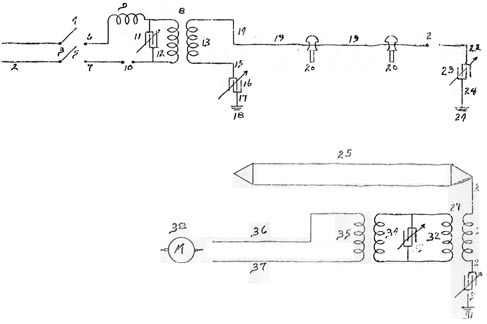
Goal
Generate electrical power by resonantly harvesting earth-generated (telluric) currents, producing more output power than the supplied electrical input.
Problem
Need for a renewable, low-cost energy source that can supply continuous electrical power without conventional fuel.
Concept Summary
The invention uses a high-frequency generator (~=500 kHz) and a long aerial antenna tuned to the natural frequency of earth currents. A spark-gap and tuned LC circuit create a resonant oscillatory loop that couples with the earth's rotational (telluric) energy, accumulating high-voltage, high-frequency currents that can be stepped down to drive loads such as motors or lighting.
Principles
- Resonant amplification of earth currents
- Frequency tuning to natural telluric frequency (~500 kHz)
- High-voltage spark-gap excitation
- Inductive coupling between transmission and receiving antennas
- Energy conversion via step-up/step-down transformers
Scientific Domains
Materials
- Copper wire (antenna)
- Insulating material for support
- Spark-gap electrodes (metal)
- Capacitors (condensers)
- Transformer core material (iron/steel)
Mechanisms of Action
- Harvesting telluric (earth) currents through a resonant antenna
- Synchronizing circuit frequency with earth-generated currents
- Accumulating high-frequency energy in a closed loop antenna
- Transforming accumulated energy to usable low-frequency, low-voltage power
Energy Sources
Applications
- Railway train control
- Industrial power supply
- Lighting systems
- Remote power generation
Claimed Performance
Produces ~3 kW of electrical power from a 500 W input, a six-fold power gain.
Experimental Evidence
The patent description states that a 18-ft loop antenna tuned to 500 kHz was able to light a series of 50 carbon lamps (~=3 kW) when the transmission antenna was energized as 500 W input.
Limitations
- Requires very long antenna (up to half-mile) and high-voltage infrastructure
- No independent experimental data or peer-reviewed validation
- Reliance on poorly quantified earth current density
- Potential safety hazards from high-voltage, high-frequency operation
Red Flags
- Extraordinary claim of generating more power than input (overunity)
- Lack of quantitative experimental data or independent replication
- Potential for misunderstanding of earth's electromagnetic properties