Goal
Provide a chemical-free, nanotechnology-based antimicrobial/antiviral/odor-removal platform for food safety, air disinfection and hygiene applications.
Problem
Microbial and viral contamination of foods, surfaces and indoor air; airborne disease transmission; indoor malodor from smoking, cooking and perspiration.
Concept Summary
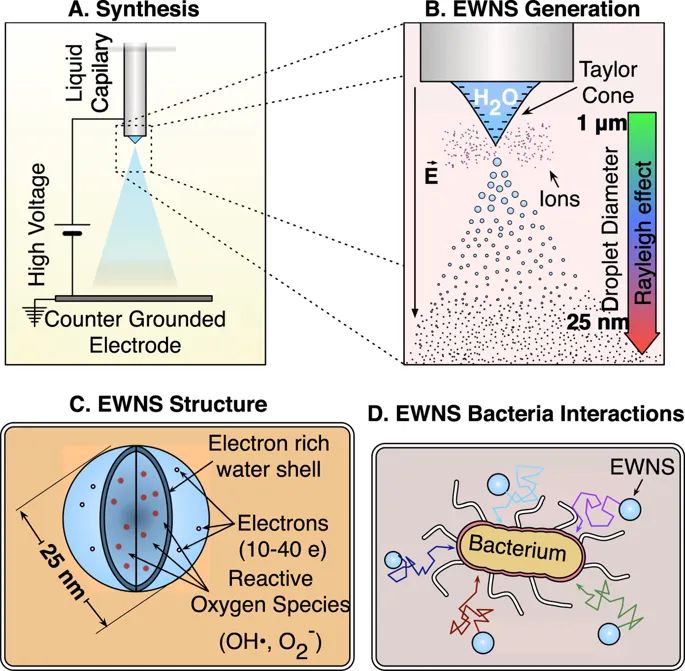
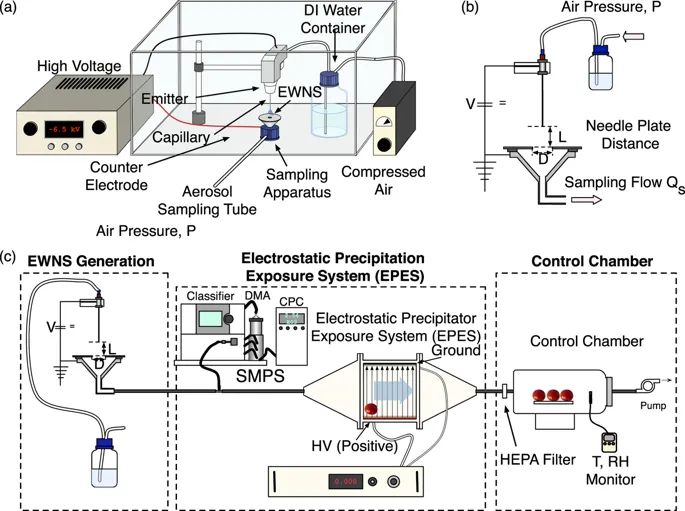
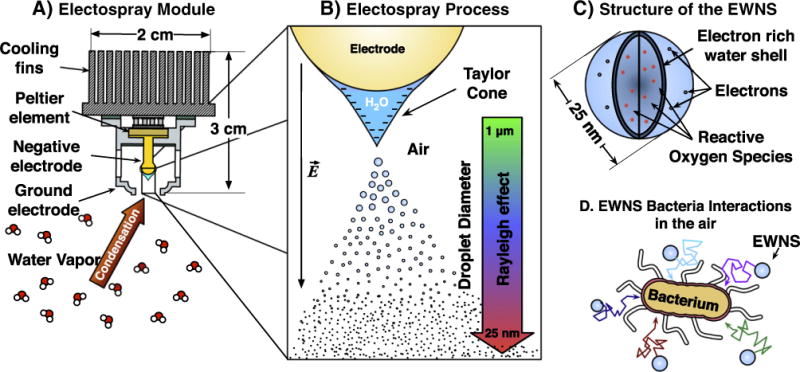
EWNS are nano-aerosols generated by electrospraying high-purity water vapor. The droplets acquire a high electrical charge and encapsulate reactive oxygen species (ROS) such as hydroxyl and superoxide radicals. The charged, ROS-laden nanostructures remain airborne for >1 h, interact with microorganisms or odorous molecules, and inactivate them through oxidative damage to membranes or chemical oxidation of odorants.
Principles
- Electrospray aerosol generation
- Encapsulation of reactive oxygen species
- High surface charge (Rayleigh instability)
- Oxidative inactivation of microbes
- Chemical-free de-odorization
Scientific Domains
Materials
- High-purity water
Mechanisms of Action
- Delivery of ROS to microbial cell membranes
- Lipid peroxidation and membrane disruption
- Oxidation of volatile organic compounds (odorants)
- Electrostatic attraction of charged particles to targets
Energy Sources
Applications
- Food-surface antimicrobial treatment
- Airborne pathogen inactivation in hospitals, public spaces
- Indoor odor mitigation
- Hand-hygiene enhancement
Claimed Performance
Microbial removal of 1.0-3.8 log after 45 min at an EWNS dose of 40 000 #/cm^3; odor-removal efficiencies of 95.3 % +/- 0.1 %, 100 % +/- 0.0 % and 43.7 % +/- 2.3 % for three representative indoor odors.
Experimental Evidence
Laboratory studies demonstrated ROS-laden EWNS inactivate E. coli, Salmonella, Listeria, Mycobacterium parafortuitum and Saccharomyces on tomato surfaces and in air; acute mouse inhalation study showed minimal toxicity; odor-removal tests using GC-MS quantified >95 % removal of smoking, cooking and perspiration odors.
Replication Status
Results reported from multiple independent laboratory experiments (Harvard group, 2014-2019). No commercial scale replication reported.
Limitations
- Requires high-voltage equipment and controlled humidity
- Scalability to large indoor volumes not yet demonstrated
- Long-term inhalation safety of ROS-laden aerosols needs further study
- Energy consumption of electrospray generators