Goal
To determine energetic and physical conditions, radiation sensitivity, and energetic anomalies for biodetection and dowsing.
Problem
Existing dowsing and biodetection instruments are unsatisfactory, lacking sensitivity, reproducibility, and resistance to magnetic interference.
Concept Summary
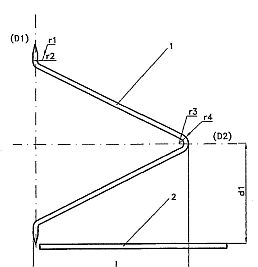
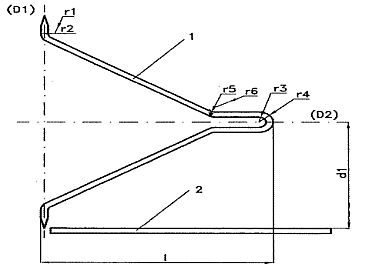
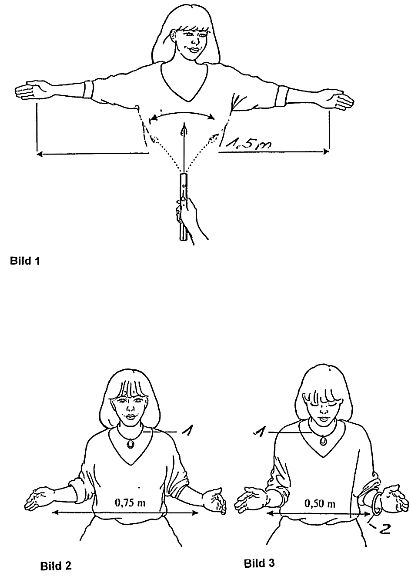
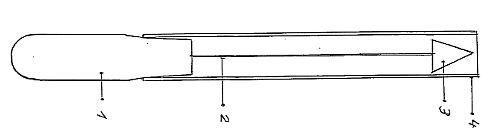
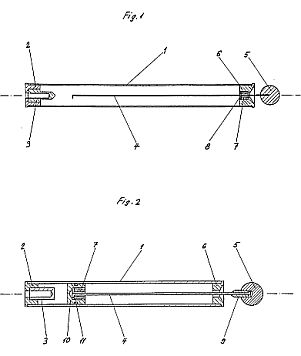
A spring pendulum consisting of a metal tube, an elastic wire spring, and a non-magnetic mass ball. The spring slides within a protective sleeve and is clamped by a rubber or plastic bearing, providing high sensitivity to magnetic/electric radiation while being insensitive to local magnetic fields. The device is used together with a special protractor for qualitative and quantitative measurements of energetic fields.
Detailed Description
The invention comprises a cross-shaped radiesthesia rod (RO123463) and a spring pendulum test device (DE4116941). The pendulum includes a handle and a metallic protective tube (non-magnetic stainless steel, Cr/Ni alloy), an extractable elastic wire spring (tempered Cr/Ni steel), and a mass element (steel ball). The spring is held radially by an elastic clamp made of natural rubber, nylon, or polyamide (PA6). Various embodiments describe different tube dimensions, spring diameters, and bearing materials (brass stop plate, Viton rubber). The device is designed for small size, maneuverability, long life, and high sensitivity to radiation effects, with claimed insensitivity to local magnetic fields.
Principles
- Mechanical vibration
- Pendulum motion
- Radiesthesia (dowsing)
- Magnetic field insensitivity
Scientific Domains
Materials
- non-magnetic stainless steel (Cr/Ni alloy)
- brass
- polyamide (PA6)
- natural rubber
- nylon
- Viton 75 SH A (fluoroelastomer)
- tempered Cr/Ni steel wire
- steel ball (AISI 111 W 4,401)
Mechanisms of Action
- Mechanical oscillation of spring pendulum
- Elastic clamping to control spring position
- Mass-spring dynamics to detect external radiation influences
Applications
- natural medicine
- dowsing
- biodetection
- biolocation
- energy field measurement
Claimed Performance
High sensitivity and reproducibility, long operating life, insensitivity to local magnetic fields, small size, enhanced maneuverability.
Limitations
- Reliance on subjective interpretation of pendulum motion
- No quantitative validation data provided
- Claims of detecting non-standard energetic fields
Red Flags
- Lack of peer-reviewed experimental data
- Claims of measuring undefined "energetic" and "bio-energetic" fields
- Association with radionic and dowsing, which are considered pseudoscientific