Goal
Harvest electrical power at night by using radiative cooling to create a temperature differential across a thermoelectric generator.
Problem
Lack of electricity during nighttime in off-grid or developing regions where solar panels cannot operate.
Concept Summary
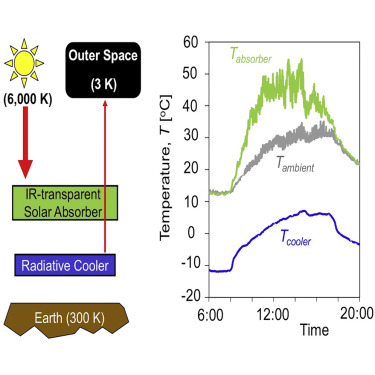
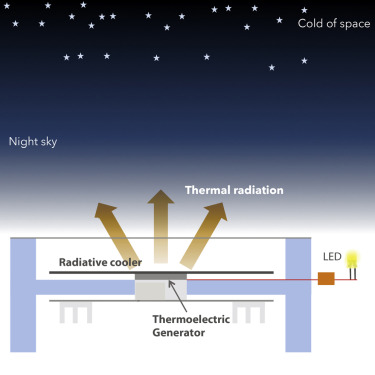
A passive device that radiates heat to the cold night sky, cooling one side of a thermoelectric module while the opposite side stays warm from ambient air. The resulting temperature gradient drives a thermoelectric generator that produces electricity, sufficient to power a low-power LED.
Detailed Description
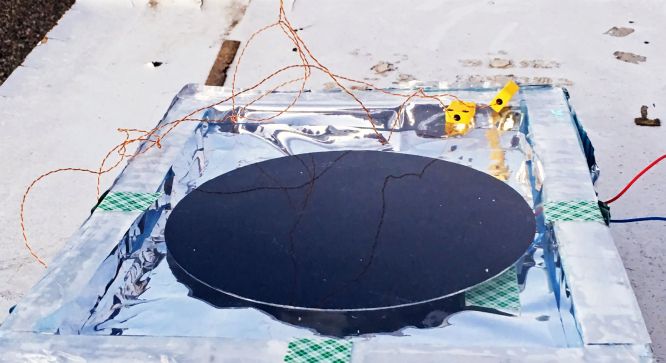
The prototype consists of a polystyrene disk coated with black paint, mounted on aluminum legs inside a wind shield. A commercial thermoelectric generator (TEG) is attached to the disk; its cold side faces the sky and radiates infrared heat to space, while the hot side contacts ambient air. The temperature difference (a few degrees Celsius) generates a voltage that, after conversion, powers a white LED. The system produced 25 mW m^-^2 under clear-sky conditions, demonstrating the feasibility of night-time power generation without batteries or solar input.
Principles
- Radiative cooling (negative illumination)
- Thermoelectric effect
- Temperature gradient driven electricity generation
Scientific Domains
Materials
- Polystyrene
- Black paint
- Aluminum
- Thermoelectric generator (e.g., Bi_2Te_3 based)
- Wind shield (plastic/metal)
Mechanisms of Action
- Infrared radiation to cold outer space lowers temperature of sky-facing surface
- Ambient air heats opposite side of thermoelectric module
- Seebeck effect converts temperature difference into electric current
Energy Sources
Applications
- Off-grid nighttime lighting
- Low-power remote sensors
- Rural electrification in developing regions
Claimed Performance
25 mW per square meter of device area; sufficient to drive a white LED; pathways suggested to reach >0.5 W m^-^2 with existing components.
Experimental Evidence
Prototype demonstrated 25 mW m^-^2 night-time power generation and directly powered a white LED; results published in the peer-reviewed journal Joule (2019).
Limitations
- Very low power density (~=25 mW m^-^2)
- Requires clear night sky for optimal radiative cooling
- Small temperature differential limits efficiency
- Scalability to useful power levels not yet demonstrated