Confidence
0.90
Practicability
0.80
Evidence
0.40
Fringe Score
0.20
Risk
0.10
TRL
7
Goal
Provide temperature separation of a high-pressure gas into hot and cold streams for cooling, heating, fluid separation, and related applications.
Problem
Need for efficient, compact cooling/heating and fluid-separation solutions without moving parts or complex refrigeration cycles.
Concept Summary
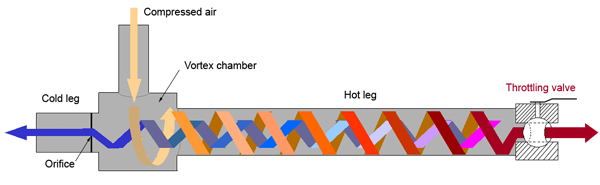
A Ranque-Hilsch vortex tube creates a high-speed, tangentially injected gas vortex inside a cylindrical chamber. The centrifugal forces and rapid expansion cause the gas to split into a hot outer stream and a cold inner stream, which can be tapped separately for various thermal and separation processes.
Principles
- Ranque-Hilsch effect
- Centrifugal separation
- Supersonic tangential injection
- Thermodynamic expansion
- Thermoelectric Seebeck effect (in some embodiments)
Scientific Domains
Materials
- steel
- copper
- porous ceramic
Mechanisms of Action
- High-pressure gas expansion
- Vortex-induced temperature separation
- Centrifugal force
- Heat exchange with external circuits
Energy Sources
Applications
- industrial gas cooling
- air-conditioning
- water desalination
- fuel-air mixing for combustion
- medical air supply
Limitations
- Requires high-pressure gas source
- Overall thermodynamic efficiency limited to ~30-40 %
- Temperature differential limited by inlet pressure and tube geometry