Goal
Provide automatic, self-priming control of irrigation water flow from a supply ditch to a field, maintaining prime during supply interruptions and reducing labor.
Problem
Conventional siphon tubes lose prime when air enters or when the water supply is temporarily interrupted, requiring manual reprime and causing water loss, labor waste, and risk of field damage.
Concept Summary
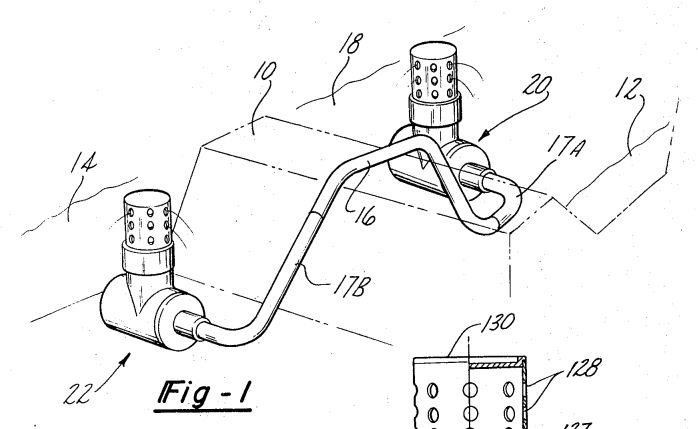
A siphon conduit equipped with a pair of float-operated valves at each end. The floats seal the valve openings when water level falls, trapping water in the conduit so the siphon stays primed. The device can be moved between channels without losing prime and flow can be adjusted by changing the outlet valve position.
Detailed Description
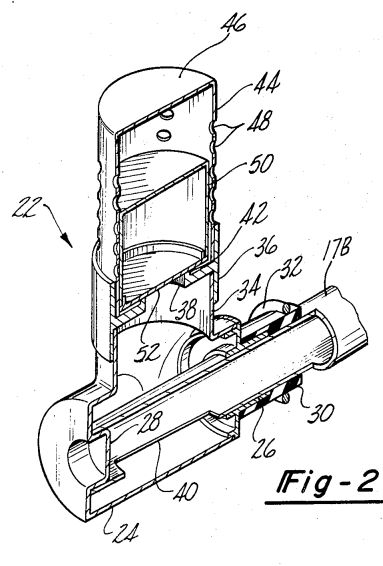
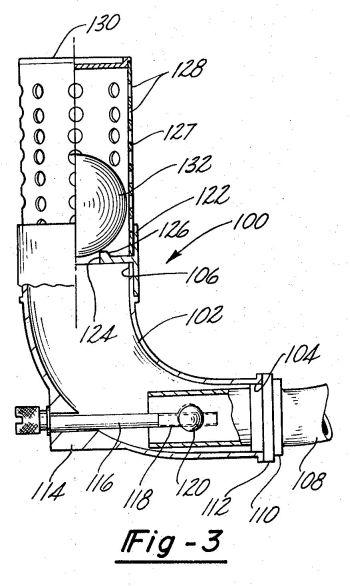
The apparatus consists of an elongated flexible conduit (PVC or similar) with L-shaped rigid pipe ends. Each end carries a valve body containing a cylindrical strainer, a resilient ring, and a buoyant float. When both valves are submerged, the floats rise, opening the water passages and filling the conduit. Once filled, the conduit can be lifted; the floats drop, sealing the openings and trapping water. If the inlet water level drops, the inlet float seals, preventing loss of prime. The outlet float similarly seals when flow should stop. The design includes strainers to block debris and shields against wind and sun. Flow rate is adjusted by raising or lowering the outlet valve.
Principles
- Buoyancy-controlled valve sealing
- Gravity-driven siphon flow
- Prime retention via closed-loop sealing
- Hydraulic flow regulation
Scientific Domains
Materials
- Flexible PVC or plastic conduit
- Rigid L-shaped pipe (plastic or metal)
- Cylindrical float (plastic or metal)
- Cylindrical strainer (plastic)
- Resilient rubber ring
- Rubber or polymer bushing
Mechanisms of Action
- Float-operated valve closes when water level falls, trapping water in the conduit
- Siphon action moves water from higher inlet to lower outlet
- Adjustable outlet valve changes hydraulic head and flow rate
- Strainer prevents debris entry
Applications
- Field irrigation for crops
- Water conservation in agriculture
- Portable irrigation setups
Claimed Performance
Device remains primed during supply interruptions, reduces labor for manual reprime, and can achieve irrigation efficiency comparable to sprinkler systems at lower cost.
Limitations
- Requires manual installation and positioning
- Performance depends on sufficient head (gravity)
- Floats and strainers may clog with debris
- No quantitative performance data provided