Goal
Create an emissions-free, high-efficiency engine that uses a refrigerant fluid as the working medium, leveraging waste heat or low-temperature heat sources to drive a piston engine.
Problem
Low efficiency and pollutant emissions (NOx, CO, HC) of conventional internal-combustion engines that rely on scarce hydrocarbon fuels.
Concept Summary
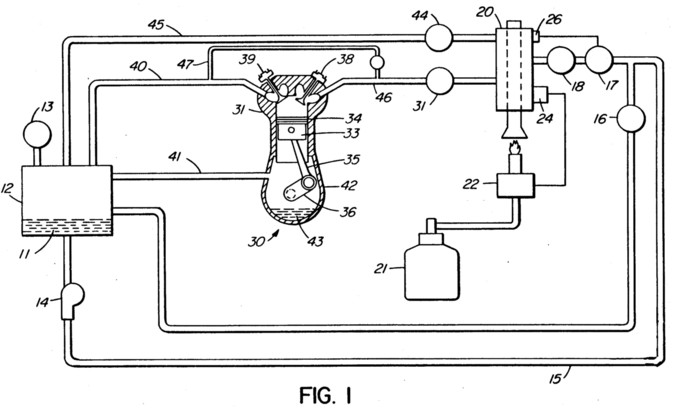
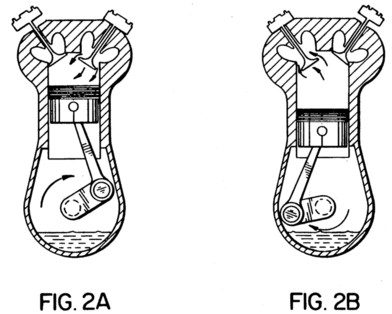
The invention is a closed-loop engine system in which a refrigerant (e.g., Freon 114) is heated by a high-efficiency hydrocarbon combustion source, vaporized, expanded in a high-compression-ratio two-stroke piston engine to produce mechanical work, then condensed back to liquid and recirculated. The cycle is claimed to achieve at least twice the efficiency of conventional engines while emitting no combustion products.
Principles
- Thermodynamics (heat-to-work conversion)
- Refrigeration cycle (liquid-vapour-condensation)
- High-compression-ratio piston engine operation
- Waste-heat recovery
Scientific Domains
Materials
- Freon 114 (C_2Cl_2F_4)
- 2,2-Dichloro-1,1,1-Trifluoro-Ethane
- Propane
- Natural gas
- Gasoline
- Oil
- Steel
- Aluminum
Mechanisms of Action
- Combustion of hydrocarbon fuel heats a chamber
- Refrigerant fluid absorbs heat and vaporizes
- High-pressure vapour expands in piston cylinder, driving crankshaft
- Exhaust vapour is condensed back to liquid and pumped to the heating chamber
Energy Sources
Applications
- Automobile propulsion
- Stationary generators
- Industrial machinery
Claimed Performance
Estimated overall efficiency at least twice that of conventional hydrocarbon-fuel internal combustion engines; closed-loop operation with no direct emissions.
Experimental Evidence
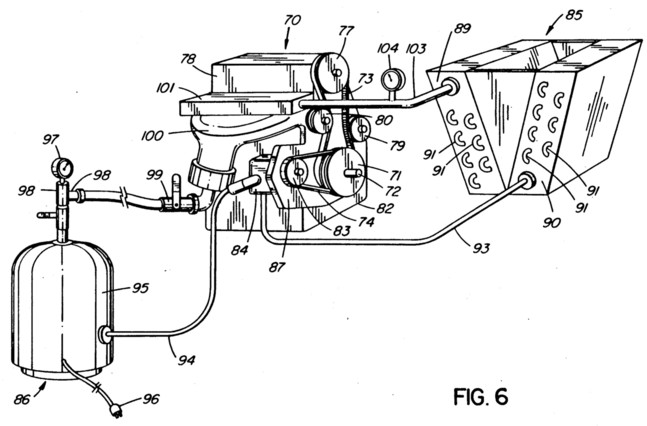
A prototype experimental apparatus (Fig. 6) was built and tested, but the article provides no quantitative performance data.
Limitations
- Requires high-pressure components and reliable sealing
- Performance claims lack quantitative validation
- Potential environmental impact if refrigerant leaks (ozone-depleting substances)
- Regulatory approval for use of refrigerants in propulsion systems
Red Flags
- Efficiency claims (twice conventional) are not supported by data
- Use of Freon 114, an ozone-depleting refrigerant, raises environmental concerns
- No independent verification or peer-reviewed testing reported