Goal
Investigate whether a small, inexpensive ceramic-magnet generator can produce self-acceleration, weight-change or other free-energy effects described for the full-size Searl Effect Generator.
Problem
The claim that rotating permanent magnets can extract energy from the environment (ether) and produce net power output, a phenomenon commonly referred to as the Searl Effect.
Concept Summary
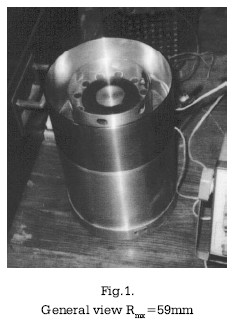
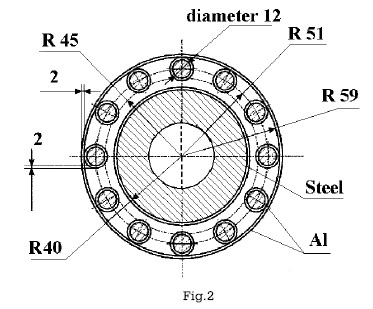
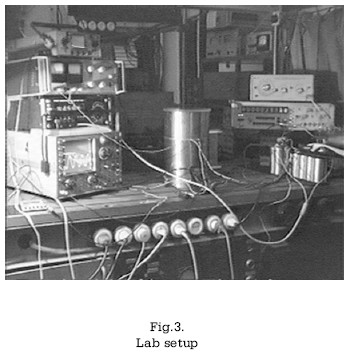
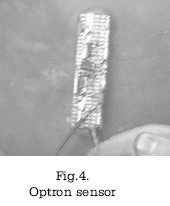
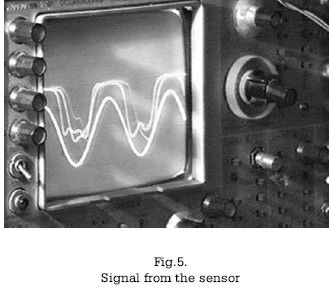
A cylindrical stainless-steel housing contains a vertically magnetized ceramic rotor magnet (cobalt-samarium) surrounded by twelve ceramic magnetic rollers. The rollers are initially attracted to the rotor and then spaced by mutual repulsion. During motor-driven rotation the rollers are expected to self-accelerate and reduce the motor's power consumption, indicating energy extraction from the surrounding medium. The prototype was instrumented with optical and inductive sensors to record rotor and roller speeds, motor current, and temperature.
Principles
- Rotating permanent magnets
- Magnetic repulsion and attraction between rollers and rotor
- Self-acceleration hypothesis
- Interaction with quantum vacuum (ether) nonlinearity
- Magnetic field confinement (concentric magnetic walls)
Scientific Domains
Materials
- Ceramic magnets
- Cobalt-samarium alloy
- Stainless steel
- Aluminum
- Copper windings
- Textolite
- Plexiglass
- Plasticine
Mechanisms of Action
- Magnetic torque on rotor
- Repulsive forces between ceramic rollers
- Possible coupling to quantum vacuum fluctuations
- Motor power consumption reduction as indicator of energy gain
Energy Sources
Applications
- Alternative energy generation
- Potential weight-reduction technology
Claimed Performance
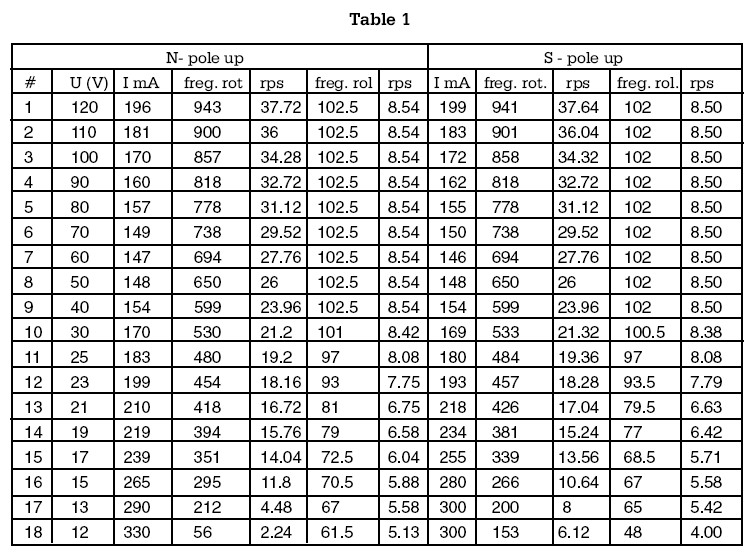
No self-acceleration of rollers was observed; motor current showed a minimal consumption region between 40 W and 80 W; no temperature or magnetic anomalies detected.
Experimental Evidence
The authors performed five test runs, measuring rotor and roller speeds with optical and inductive sensors, and recorded motor current versus supply voltage. Results showed that roller speed stabilized at ~8.5 rps regardless of further rotor speed increase, and rollers tended to retard and adhere. No self-acceleration or anomalous temperature/magnetic effects were detected.
Replication Status
Only the authors' own laboratory tests are reported; no independent replication or scaling to larger devices is mentioned.
Limitations
- No self-acceleration observed
- Roller adhesion and attrition during tests
- Short test duration (~=10 min)
- Absence of temperature or magnetic anomalies
- Limited to laboratory-scale prototype
Red Flags
- Extraordinary claim of free energy without independent verification
- Lack of peer-reviewed data or replication
- Potential measurement uncertainties due to roller adhesion and sensor corrections