Goal
Generate high-power direct-current electricity without commutation, rectification, or high-resistance sliding contacts.
Problem
High internal-resistance losses, need for multiple sliding brushes, commutation/rectification requirements, and centrifugal stress in conventional homopolar generators.
Concept Summary
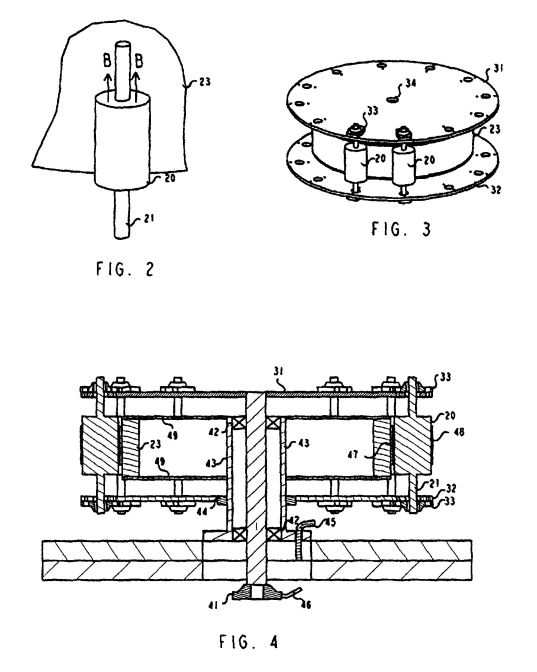
A multi-rotor homopolar machine where axially parallel cylindrical conductive magnets orbit a central stator ring. Rolling contacts replace sliding brushes, and a single high-current thrust bearing provides the only moving electrical contact. The design distributes current generation across many rotors, reducing per-rotor current and internal resistance.
Detailed Description
The invention comprises a central stationary stator ring with conductive endplates, multiple cylindrical electrically conductive magnets mounted on bearings that orbit the stator, and rolling contacts that maintain non-slip engagement between each magnet and the stator. The rotating magnets and a metallic disk co-rotate, cutting magnetic flux and inducing a DC emf (J thrust conductive a). Electrical energy is extracted via a conductive thrust bearing on the central axle and a stationary stator contact. The system eliminates most sliding contacts, uses magnetic bearings to reduce friction, and can operate as both a generator and a motor, suitable for high-speed operation and energy-storage flywheels.
Principles
- Electromagnetic induction (Faraday's law)
- Lorentz force (JxB)
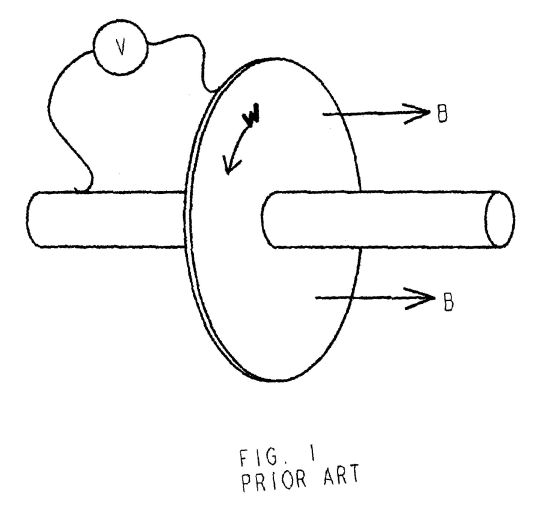
- Homopolar generation
- Rolling contact friction reduction
Scientific Domains
Materials
- Electrically conductive cylindrical magnets (e.g., neodymium-iron-boron alloy)
- Copper or aluminum conductive bearings
- Steel or aluminum stator ring
- Conductive endplates (copper/bronze)
- Insulating thrust bearing material (ceramic or polymer)
Mechanisms of Action
- Co-rotating conductive magnets cut magnetic flux
- Rolling contact transmits current without sliding friction
- Thrust bearing provides a single moving electrical contact
- Distributed generation across multiple rotors reduces internal resistance
Energy Sources
Applications
- Electric propulsion for marine vessels or railguns
- High-power DC power generation
- Energy storage via flywheel systems
- Industrial motor drives
Claimed Performance
High-power DC generation with significantly reduced internal resistance and only one high-current moving contact; no quantitative performance data provided.
Limitations
- Mechanical complexity of rolling-contact bearings
- Material wear and durability of rolling interfaces at high speed
- Need for precise alignment of multiple rotors
- Lack of published experimental performance data