Goal
To suspend a body in the air (levitation) and enable controlled horizontal and vertical motion without conventional mechanical motors.
Problem
The inability to hold a body immobile in space and to move it without traditional propulsion systems.
Concept Summary
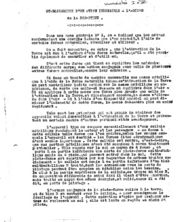
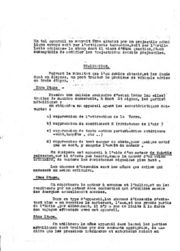
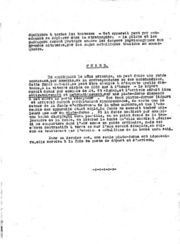
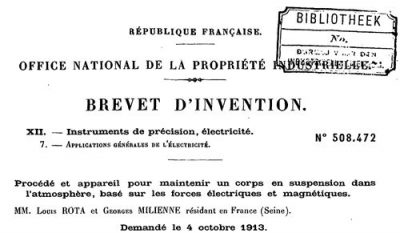
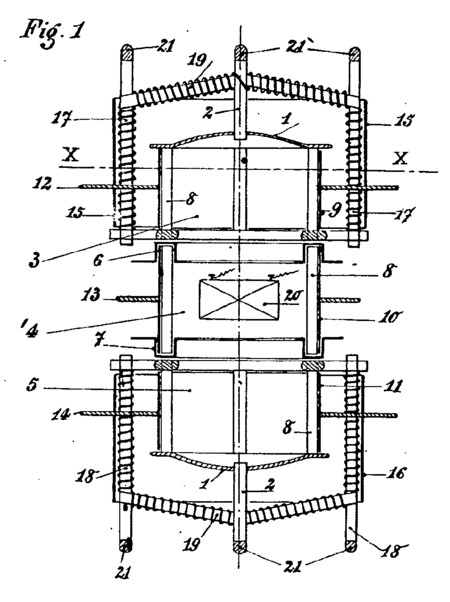
Rota's invention claims to use a special partitioning of electrostatic and magnetic forces, activated by Hertzian (radio) waves and treated metallic components, to neutralize Earth's gravitational attraction on a metallic capsule. By adjusting the balance between treated metal blocks (B and Ba) the device can lift, hover at heights of 400-1000 m, and travel at high speeds, all without a conventional motor.
Detailed Description
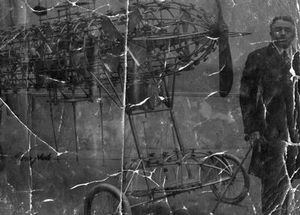
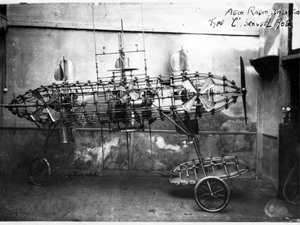
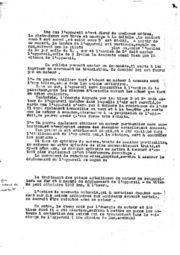
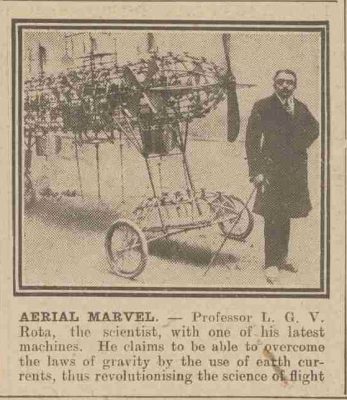
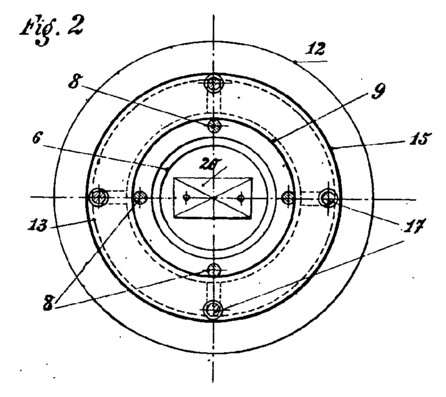
The apparatus consists of a closed metallic capsule containing a motor and passengers, supported on a multi-metallic platform with treated metal strips. Two specially treated metal blocks (B and Ba) are connected to the capsule; their interaction with the platform and each other creates a net upward force when the Earth's attraction is neutralized. The device can be rolled a few metres to initiate lift, after which the blocks are switched to control ascent or descent. Forward motion can be supplied by a conventional petrol engine or a claimed non-combustion motor powered by the same treated metals. The treatment of the metals is said to generate a zone of rarefied air, reducing drag and wind effects. The system is purported to be controllable via radio (Hertzian) waves.
Principles
- Electrostatic force manipulation
- Magnetic force manipulation
- Use of Hertzian (radio) waves
- Telluric current utilization
- Electrogravitation
Scientific Domains
Materials
- Metallic capsule
- Copper cylinder (treated)
- Zinc cylinder (treated)
- Metallic strips
- Multi-metallic blocks B and Ba
Mechanisms of Action
- Electrostatic repulsion
- Magnetic attraction/repulsion
- Interaction with specially treated metal surfaces
- Radio-wave induced force modulation
Energy Sources
Applications
- High-speed transportation
- Military logistics
- Wireless communications
- Resource exploration
Claimed Performance
Lift 45 kg, sustain 24 h at altitude 400-1000 m; travel 200 km; speed up to 1000 km/h; altitude control within wind speeds < 14 m/s.
Experimental Evidence
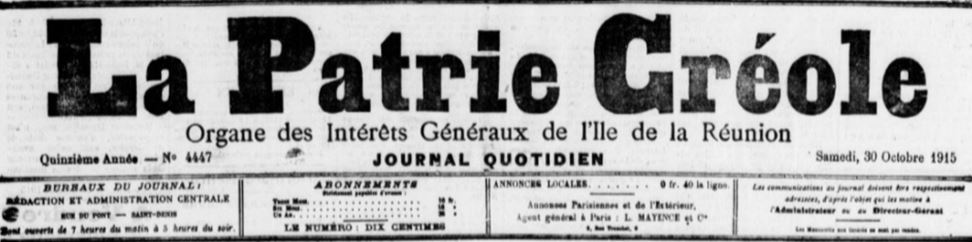
The article reports a prototype 4 m long, 75 cm diameter, 95 kg capsule that lifted 45 kg for 24 h, moved 200 km, and could travel Marseille-Paris (653 km) in 3 h and Paris-Turin (585 km) in 2.25 h.
Replication Status
Only the original author's reported experiments; no independent replication documented.
Limitations
- No reproducible experimental data
- Mechanism of metal treatment not described
- Reliance on undefined "natural forces"
- Lack of peer-reviewed validation
Red Flags
- Extraordinary anti-gravity claims without quantitative evidence
- Historical anecdotal reports rather than scientific documentation
- Potential pseudoscientific terminology (e.g., "telluric currents", "latent energy")