Goal
To locate and indicate the presence, direction, depth and quality of underground resources such as water, minerals, petroleum and coal, and to analyse unknown substances by using interchangeable reacting cartridges.
Problem
Traditional divining rods provide only a simple vertical pull indication and cannot directly give directional or oscillation data needed to assess depth, thickness or quality of underground treasures.
Concept Summary
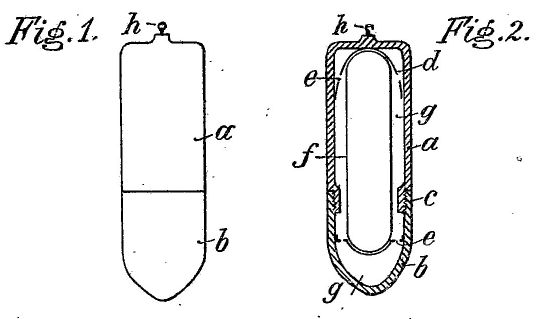
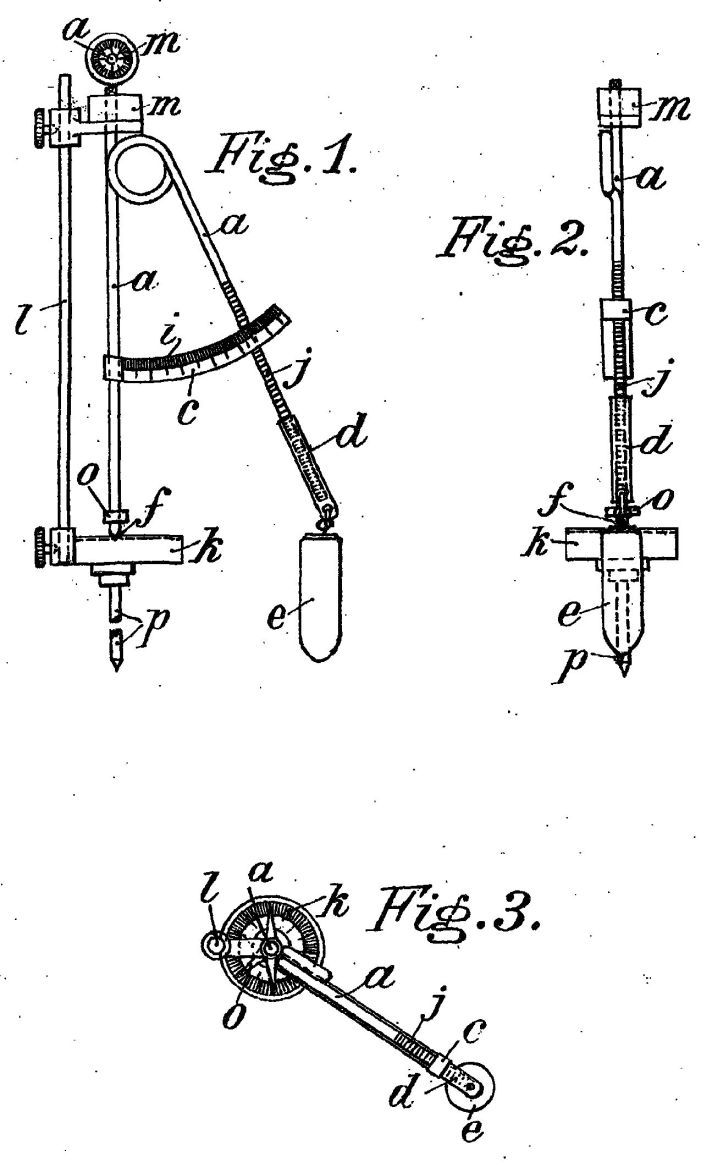
The invention modifies a conventional divining rod by making the two branches elastic, mounting the rod between a compass and a speed-indicator, and attaching interchangeable cartridges containing substances that react to the emanations of underground targets. The reacting substance causes the rod to oscillate and rotate; the number of oscillations is read on the speed-indicator and the direction of attraction is read on the compass, allowing direct inference of the target's location and characteristics.
Principles
- Mechanical oscillation of a bent rod
- Rotational coupling to a compass for directional read-out
- Speed indication of oscillations
- Chemical/physical reaction of a cartridge substance to unknown subterranean emanations
Scientific Domains
Materials
- Wood
- Metal (e.g., brass, steel)
- Cartridge material (unspecified reacting substance)
- Glass or metal capsule for cartridge
Mechanisms of Action
- Attraction or repulsion of the rod by unknown emanations
- Induced rotation and oscillation of the elastic branches
- Conversion of oscillation frequency to a speed-indicator reading
- Directional pointing via a compass mounted on the rotating branch
Applications
- Resource exploration (water, minerals, petroleum, coal)
- Subsurface analysis of unknown materials
Claimed Performance
Direct read-out of oscillation count and compass direction to locate underground treasures and infer their depth, thickness and quality; ability to test unknown substances by swapping reacting cartridges until a matching reaction is observed.
Limitations
- No quantitative or peer-reviewed data supporting the claimed performance
- Reliance on undefined "emanations" from underground targets
- Subjective interpretation of oscillation and compass readings
- Lack of calibration methodology
Red Flags
- Claims based on unverified "emanations" and dowsing principles
- Absence of experimental data or independent replication
- Potential classification as pseudoscience