Goal
Provide a compact, efficient, multi-fuel power source that can generate electricity or mechanical work for vehicles, military platforms, and robots while reducing emissions and eliminating the need for lubricating oil.
Problem
Reliance on internal-combustion engines that require specific fuels, emit pollutants, need oil lubrication, and are larger and heavier than desired for many applications.
Concept Summary
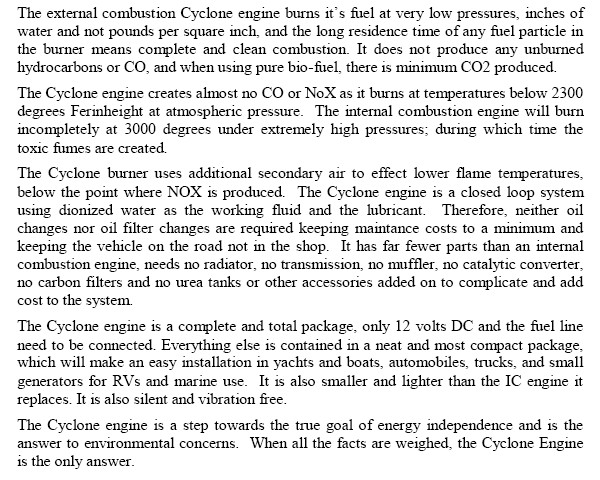
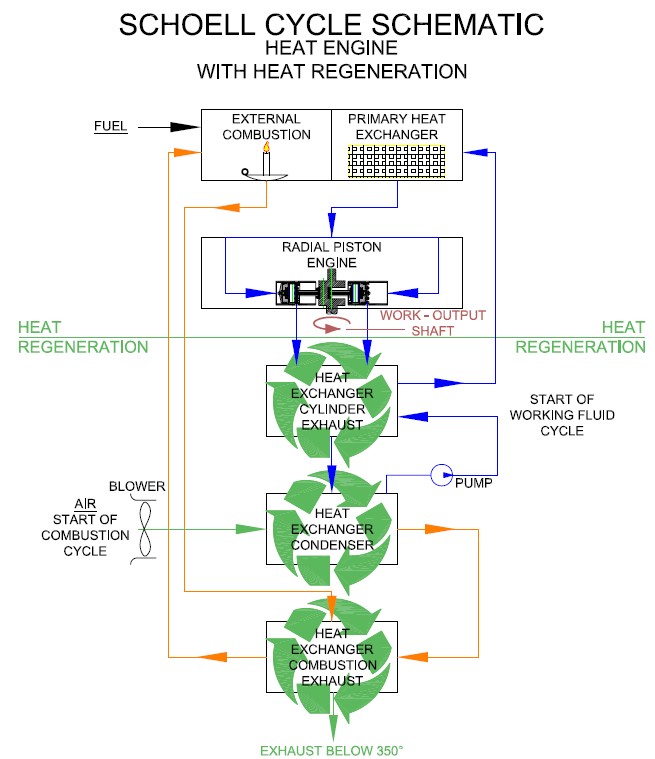
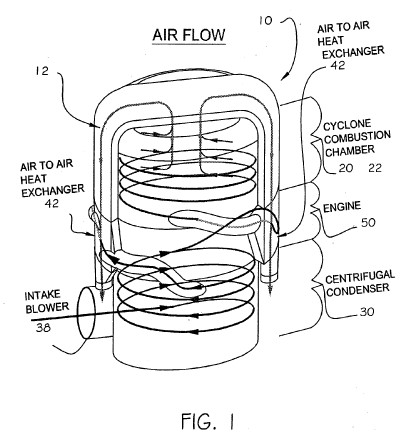
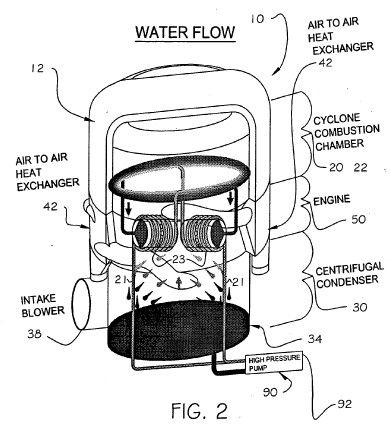
The Cyclone engine is an external-combustion device that mixes fuel and air in a cyclonic swirl inside a round combustion chamber, heating deionized water to a supercritical fluid. The high-pressure fluid expands through a piston to produce work, then passes through a series of heat exchangers that recover heat and recycle the water in a closed loop. The engine can run on virtually any combustible material, does not require oil lubrication, and claims higher efficiency and lower emissions than conventional engines.
Principles
- External combustion
- Cyclonic swirl for fuel-air mixing
- Heat regeneration (heat-exchange recovery)
- Supercritical fluid steam cycle
- Closed-loop water/steam cycle
Scientific Domains
Materials
- Deionized water
- Steel
- Copper
- Aluminum
Mechanisms of Action
- Fuel-air mixing via cyclonic swirl in combustion chamber
- Combustion heating of deionized water to supercritical state
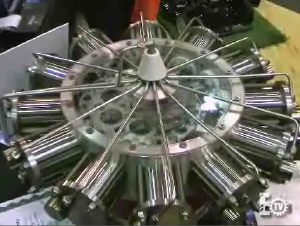
- Expansion of supercritical fluid to drive piston
- Heat exchange to recover energy and pre-heat incoming water
- Closed-loop water circulation with condensation
Energy Sources
Applications
- Vehicle power generation (cars, trucks, boats)
- Military generators for tanks and fighting vehicles
- Torpedo and unmanned underwater vehicle propulsion
- UAV power systems
- Robotic power for long-endurance missions
Claimed Performance
Smaller, simpler, cleaner, quieter and more economical than internal-combustion engines; can run on almost any fuel; eliminates need for oil lubrication; high thermal efficiency due to heat regeneration.
Experimental Evidence
Prototype engines have been tested with Raytheon for naval applications, have won SAE awards in 2006 and 2008, and were featured in Popular Science's 2008 Invention of the Year. The U.S. Army and Navy have expressed interest, and DARPA is studying a biomass-fuel version for robots.
Replication Status
Prototype tested and demonstrated to multiple military and commercial partners; no large-scale commercial production reported.
Limitations
- Requires high-pressure water system and robust heat exchangers
- Complexity of closed-loop supercritical fluid handling
- Scale-up and long-term durability not yet proven
- Fuel handling for very dirty or solid fuels may need preprocessing
Red Flags
- Broad claim of "any fuel" without detailed performance data
- Lack of independent, peer-reviewed test results
- Commercial deployment has not yet materialized despite several years of prototype testing